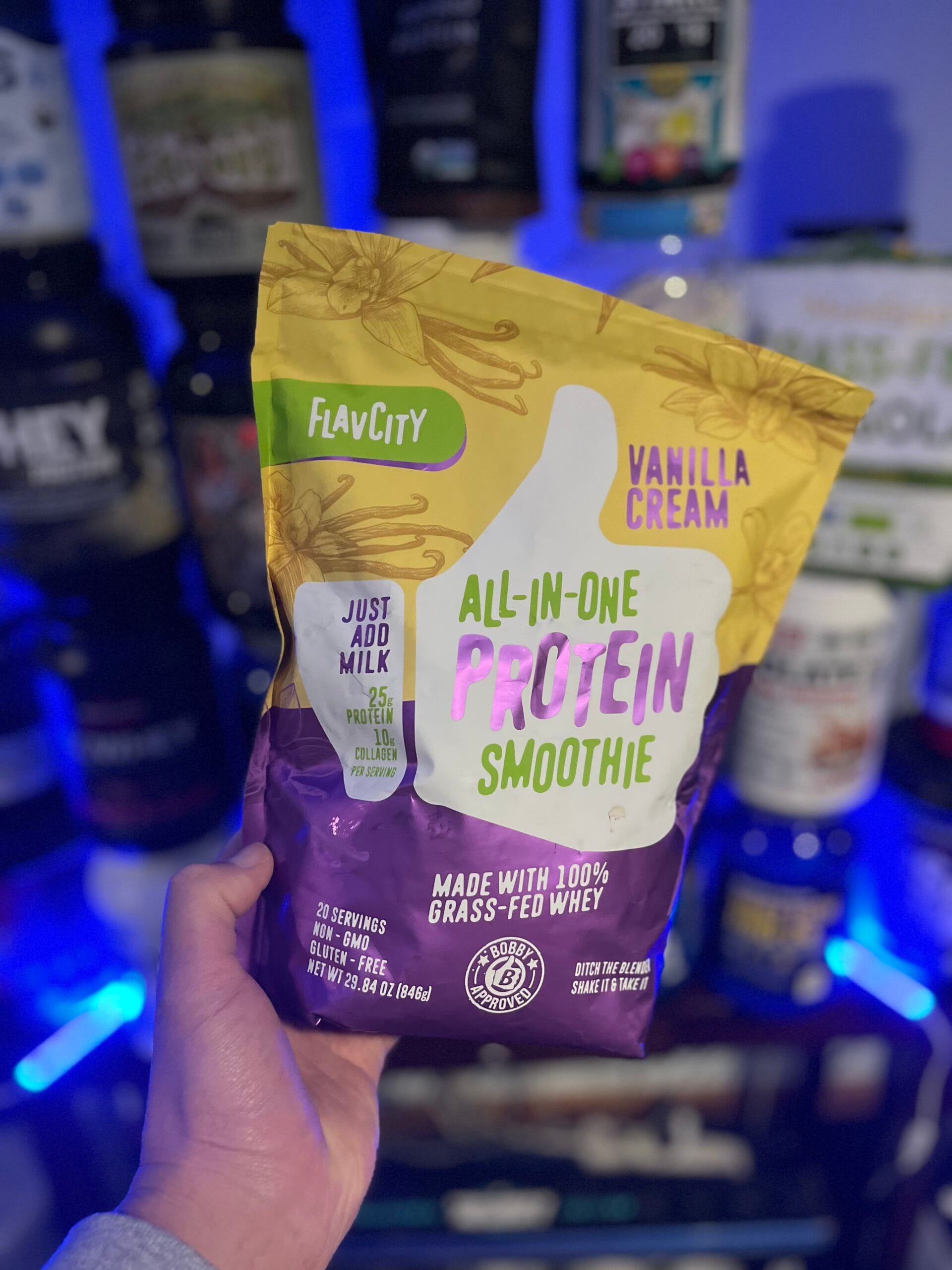
FlavCity Protein Powder Review – Is This “Healthy Shake” Worth the Premium Price?
FlavCity Protein Powder markets itself as a clean, convenient smoothie replacement, but does it deliver the transparency and performance to justify its price?
Before You Spend $60: The Truth About This “Healthy” Smoothie Powder
FlavCity Protein is a smoothie-style shake you’ll actually drink. In water, it mixes fast with only light residue, and the Vanilla Cream profile drinks more banana-coconut than dessert-vanilla. FlavCity Protein also discloses 10g collagen, so it’s not sneaky amino spiking, but there’s still no amino acid profile to verify leucine/BCAA yield. The brand claims testing, yet no batch COAs include receipts, and the Prop 65 warning language appears online, not on the bag. FlavCity Protein fits busy, health-first snackers, not performance purists.
Pros
- Great mixability and drinkability
- Collagen amount disclosed
- Clean-label feel, no artificial sweeteners
Cons
- No amino panel (leucine/BCAA unverified)
- No batch-linked COAs
- Prop 65 messaging mismatch (site vs bag)
FlavCity Protein Powder Review TL;DR
- Amino integrity: No amino acid profile provided, leaving leucine and BCAA yield unverified.
- Third-party testing: Claims third-party testing, but lacks batch-matched verification or COAs for actual product transparency.
- Label transparency: Missing critical %DV, PDCAAS, and no proof of “grass-fed” claims or sourcing documentation.
- Price justification: The premium price ($60 for 20 servings) isn’t supported by sufficient evidence or transparency.
Final Score: 31/50 (62%) — Questionable Purchase.
How I Review Protein Powder
As a certified strength and conditioning specialist (NSCA) and sports nutrition professional (CISSN), I review protein products using a detailed, evidence-based framework. I analyze label accuracy, amino integrity, transparency of third-party verification, safety disclosures, and real-world usability.
In this FlavCity Protein review, I dive deep into the specifics, including the missing amino acid profile, the lack of third-party testing, and transparency concerns about the grass-fed claims. If FlavCity fails to substantiate its promises, that gap directly impacts the final score.
I don’t take brand claims at face value. My reviews focus on what can be verified, what’s missing, and how those gaps affect performance expectations, buyer trust, and value.
For a full breakdown of my evaluation process, check out my YouTube channel here: JKremmerFitness YouTube.
Table of contents
- FlavCity Protein Powder Review – Is This “Healthy Shake” Worth the Premium Price?
- FlavCity Protein Powder Review TL;DR
- How I Review Protein Powder
- Is FlavCity All-In-One Protein Smoothie Amino Spiked? (Short Answer)
- Third-Party Testing, Safety, and Quality Verification (Short Answer)
- Ingredient Accuracy, Grass-Fed Claims, and Safety Disclosures (Short Answer)
- Nutrition Facts, Protein Density, and Label Integrity (Short Answer)
- Mixability, Texture, and Flavor Accuracy (Short Answer)
- Price, Value, and Availability (Short Answer)
- Brand Comparison: How It Stacks Up Against Competitors (Short Answer)
- FlavCity Protein Reviews: What Real Customers Are Saying On Amazon (Short Answer)
- FlavCity Protein Powder Review – Final Thoughts (Before You Buy)
- FlavCity Protein Review Round-Up (Score Summary)
- FAQ – FlavCity Protein Powder
Is FlavCity All-In-One Protein Smoothie Amino Spiked? (Short Answer)
Is FlavCity All-In-One Protein Smoothie Amino Spiked? No. This formula reads like a straightforward whey protein + collagen blend, not a “cheap amino filler” workaround.
- Collagen is clearly disclosed at 10g per serving, not buried inside vague blend language.
- The ingredient list stays specific, supporting the brand’s clean protein positioning.
- The only limitation is verification: there’s no amino acid profile, so leucine/BCAA yield can’t be confirmed for strict performance expectations.
Amino Spiking Score: 6.5/10
If you want the full label-first reasoning, the evidence breakdown below walks through collagen disclosure, protein verification limits, and what that means for real-world muscle-building use.
Is FlavCity All-In-One Protein Smoothie Amino Spiked?
No. FlavCity Vanilla Cream does not appear to be amino-spiked based on the label and ingredient list. This is an all-in-one smoothie protein powder built around a whey protein + collagen blend, not a formula padded with cheap amino fillers.
What matters most for buyers:
- The ingredients are specific (no vague protein blend language)
- Collagen is clearly disclosed (not hidden inside “protein matrix” or undisclosed ingredient list nonsense)
- The only missing piece is a full amino acid profile, which would confirm leucine/BCAA yield
Real-world consequence:If your goal is a smoothie replacement protein that mixes easily and uses real ingredients, this looks like a clean formula. If you’re buying strictly for max protein efficiency per scoop, you’d want the amino panel to confirm how much of that 25g behaves like true whey-driven muscle protein.
Collagen Is Boosting The Protein Number (But It’s Disclosed Up Front)
No, this isn’t amino spiking. In FlavCity All-In-One Protein Smoothie, the “extra protein” comes from collagen that’s clearly disclosed, which is fundamentally different from hiding cheap amino fillers. From a compliance standpoint, FDA labeling rules also treat protein claims differently, since “such a statement shall be given if a protein claim is made” under the FDA’s 21 CFR 101.9(c)(7)(i) protein labeling requirement.
- The bag calls out 10g collagen per serving right next to 25g protein (this is a disclosed whey protein + collagen blend)
- The primary protein source is grass-fed whey protein concentrate (undenatured), not a vague “protein matrix”
- The formula is built as an all-in-one smoothie protein powder (coconut milk powder, banana powder, vanilla, stevia/monk fruit), not a stripped-down whey protein powder shake
Why this matters for the buyer: collagen can inflate the total “protein” number without delivering the same muscle-building value as whey, so you’re paying for a smoothie replacement protein experience, not maximum MPS efficiency.
No Amino Acid Profile Means You Can’t Verify Protein Quality
You can’t fully verify protein quality here because there’s no amino acid profile listed. FlavCity All-In-One Protein Smoothie may still be a clean protein formula. Still, without amino data, buyers can’t confirm the leucine/BCAA yield or how “performance-ready” this high-quality protein drink really is. FDA protein labeling rules even account for protein quality, stating the corrected protein amount is “equal to the actual amount of protein (gram) per serving multiplied by the amino acid score corrected for protein digestibility” under the FDA’s protein quality correction method (21 CFR 101.9(c)(7)(ii)).
- 25g protein per serving with a 42.3g scoop (about 59% protein by weight)
- The formula includes multiple add-ins (coconut milk powder, banana powder, sweeteners, mushrooms), which is normal for an all-in-one smoothie protein powder but lowers protein density
- No amino panel is provided, so buyers can’t confirm leucine/BCAA yield or whether it performs like a straight whey protein powder shake
Why this matters for the buyer: without amino verification, you’re buying the smoothie replacement experience on trust, not measurable MPS precision.
No Verification Support From The Brand Limits Buyer Confidence
You can’t fully verify key quality details here because the brand didn’t respond to direct questions. With FlavCity All-In-One Protein Smoothie, the label may look clean, but when a company markets a premium “clean protein” product, silence is still a transparency fail. FDA rules also expect clarity when protein claims are made, since “such a statement shall be given if a protein claim is made” under the FDA’s protein labeling requirements (21 CFR 101.9(c)(7)(i)).
- You reached out by email and got no reply, with no alternate communication channel available
- Online product images show “packaging may vary,” meaning the formula can change without obvious notice
- The product is priced at $2.99 per serving, so a lack of verification support is harder to excuse at this tier
Why this matters for the buyer: if you’re paying premium pricing for a smoothie replacement protein, you should be able to confirm basic label integrity questions without playing email roulette.
How Many Scoops of FlavCity All-In-One Protein Smoothie Stimulate Muscle Protein Synthesis (MPS)?
For MPS, plan on 2 scoops if you want a confident leucine hit. One scoop can work, but it’s a “probably” because 10g of the 25g protein is collagen, leaving roughly 15–16g of whey-driven protein to do the muscle-building heavy lifting.
Here’s the MPS reality: you’re typically trying to reach ~2–3g of leucine to fully trigger the response. The catch is collagen doesn’t meaningfully move that needle. Research is blunt about it: “whey protein but not collagen peptides stimulate… muscle protein synthesis” when compared head-to-head in a controlled setting, which is why collagen is better treated as an add-on, not the engine. And since this formula uses whey protein concentrate, it’s also worth noting the literature discusses MPS differences across whey types, including the line that native whey may have a “greater MPS-stimulating ability than WPC-80.”
Natural reference protein (quick and useful): plain milk is a complete protein with predictable MPS behavior. This product is a whey protein + collagen blend, so the MPS punch depends on the whey portion, not the collagen headline.
3-point breakdown
- What we know: the base protein is grass-fed whey protein concentrate, which is the right type of protein for MPS when dosed high enough
- What we can’t verify: exact leucine/BCAA yield, because there’s no amino acid profile to confirm the scoop’s MPS “trigger” strength
- What you should realistically do post-workout: use 2 scoops when muscle building is the goal, or use 1 scoop + a real complete-protein food (milk, Greek yogurt, eggs, meat) to close the leucine gap
Practical prescription: If your goal is MPS, 2 scoops is the cleanest, least-complicated answer; if you want to stay at one scoop, pair it with a known complete protein source and you’ve basically solved the problem.
Amino Spiking Score: 6.5 out of 10
FlavCity earns credit because the formula doesn’t look like a typical amino-spiking setup. Collagen is disclosed up front as 10g per serving, and the ingredient list is specific, with no vague “protein matrix” or mystery blends doing the heavy lifting.
The issue is verification: without a full amino acid profile, buyers can’t confirm leucine/BCAA yield or whether the whey portion performs like a true MPS-focused whey protein powder shake. In real terms, that means you can trust the label’s honesty, but you can’t fully trust the muscle-building precision without more data.
Third-Party Testing, Safety, and Quality Verification (Short Answer)
Current third-party testing is claimed, not shown. FlavCity says it “rigorously and continually” uses a third party to lab-test ingredients for contaminants like heavy metals and “more.” Still, there are no published, batch-matched results in the evidence provided that a buyer can actually audit.
- COAs: None were provided or linked, so recency, batch relevance, and completeness can’t be confirmed.
- Verification programs: No visible NSF, Informed Sport/Informed Protein, Labdoor, or equivalent certification trail in the materials reviewed.
- Prop 65: My bag does not display a Prop 65 warning; that disclosure appears only on some online sites, suggesting packaging or formula variations and increasing the need for documentation.
- Transparency vs marketing: “Clean protein” language and ingredient quality claims are present, but the data trail (amino profile, leucine/BCAA yield, batch results) isn’t.
Transparency verdict: Strong branding, weak documentation.
Is FlavCity Protein Powder Third Party Tested For Thier Claims?
FlavCity claims third-party lab testing, but what’s missing is the part buyers can actually audit. On their official “About Us” page, they say they “rigorously and continually utilize a third party to lab-test ingredients” for “heavy metals, forever chemicals, fluoride, and more,” which is a strong promise on paper.
Here’s the problem: that statement is ingredient testing language, not a published, batch-matched verification record for the finished FlavCity Protein Powder you’re buying.
- The brand claims ongoing third-party lab testing of ingredients, but provides no visible batch-linked proof in what you’ve shared
- There’s still no posted amino acid profile, so leucine/BCAA yield can’t be verified for performance expectations in this whey protein + collagen blend
- There’s no clear, current verification stamp or published program listed (NSF, Informed Sport, Informed Protein, Labdoor) in the evidence provided
- You reached out by email for verification and got silence, which is not how “trusted source” branding is supposed to work in the real world
Verdict: FlavCity’s verification claims are plausible but incomplete. The brand is telling you the right story (third-party testing), but without published results tied to current product batches, it functions more like a trust statement than a verifiable standard.
Is FlavCity Third Party Tested? Certificates of Analysis, Batch Testing, and Data Transparency
On paper, FlavCity is selling “we test everything” energy. Their standards page explicitly says they use a third party to lab-test ingredients for contaminants and “more.” The issue is data transparency: there’s no COA trail shown in what you provided, and no batch-level records for a buyer to actually check.
- The brand makes a broad testing claim (“lab-test ingredients”), but no COAs were provided or linked in the materials you shared
- There’s no way to verify whether any testing is current, continuous, or tied to today’s batches (especially with “packaging may vary” appearing in online imagery)
Critical datapoints for protein integrity still aren’t documented: amino profile, leucine, total BCAAs, and any batch-specific purity results
Why this matters: In a high quality protein drink category, “we test” is a claim. A COA is the receipt. Without the receipt, accuracy becomes assumption, and that matters more when the product is priced like a premium smoothie replacement protein.
Verdict: This reads like real standards being claimed, but documentation not being shown. In other words: transparency by statement, not transparency by records.
Ingredient Accuracy, Grass-Fed Claims, and Safety Disclosures (Short Answer)
This section separates what FlavCity claims from what you can actually verify: a clean, specific ingredient list, an unverified “grass-fed” story with no named certification, and Prop 65 safety messaging that lives on the website, not the bag.
FlavCity Protein Powder Ingredients Overview
The ingredient panel makes one thing obvious: FlavCity markets this as a clean protein and the bag leans into “no artificial sweeteners,” but the label reads like a clean-label smoothie mix. This is an all-in-one smoothie protein powder built for taste, texture, and convenience.
Primary protein source: The formula starts with whey protein concentrate, followed by collagen, which frames the product as a whey protein + collagen blend rather than a stripped-down whey isolate. That’s not a criticism. It’s just the category.
Flavor system (what creates the Vanilla Cream profile): The middle of the label is basically a smoothie base: coconut milk powder, banana powder, and vanilla powder, with unrefined sea salt used to sharpen the flavor and keep it from tasting flat.
Sweeteners and additives: Sweetness comes from organic stevia leaf extract and monk fruit extract, which matches the “no artificial sweeteners” positioning from the older packaging. Also worth noting: there are no gums, enzymes, stabilizers, or emulsifiers listed, which is uncommon for a creamy, shaker-friendly product, making the ingredient panel feel more straightforward than most “smoothie” powders.
Unusual placements and ordering that matter: Compared to the old formula order, the new label reshuffles a few items (banana/coconut swap and the sweeteners moving ahead of the mushrooms). That doesn’t tell us “better” or “worse,” but it does change emphasis: the new order reads more like “smoothie base first, functional add-ins last,” which is exactly how the product is positioned.
Old vs new formulation:The ingredient list reshuffle is subtle but real. In the newer label order, cordyceps and reishi appear lower, and the wording shows fewer “organic” descriptors for certain ingredients than in the older list. This doesn’t prove the formula changed in a meaningful way, but it does shift the label’s emphasis: more on the smoothie base and sweeteners, less on the functional add-ins.
Takeaway: If you want a minimalist whey protein powder shake, this isn’t it. If you want a smoothie replacement protein that keeps the label specific, avoids artificial sweeteners, and skips the usual gum-heavy thickener stack, the ingredient panel clearly supports that goal.
| FlavCity Vanilla Cream New vs Old Formulation, All-In-One Smoothie Protein Powder Ingredient List | ||||
| Old Formula Order | Old Formula Ingredient Order | New Formula Order | New Formula Ingredient Order | Purpose |
| 1 | Whey Protein Concentrate (grass-fed, undenatured) | 1 | Whey Protein Concentrate (grass-fed, undenatured) | Primary complete-protein base. This is the core “whey protein powder shake” component that carries most of the muscle-building utility in the whey protein + collagen blend. |
| 2 | Collagen (grass-fed) | 2 | Collagen (grass-fed) | Adds protein grams and structure to the blend, but it’s not interchangeable with whey for MPS expectations. |
| 3 | Organic Banana Powder | 3 | Coconut Milk Powder | Flavoring |
| 4 | Organic Coconut Milk Powder | 4 | Banana Powder | Flavoring |
| 5 | Vanilla Powder | 5 | Vanilla Powder | Flavoring |
| 6 | Unrefined Sea Salt | 6 | Unrefined Sea Salt | Flavoring |
| 9 | Organic Steavia Leaf Extract | 7 | Organic Steavia Leaf Extract | Natural Sweetener |
| 10 | Organic Monk Fruit Extract | 8 | Monk Fruit Extract | Natural Sweetener |
| 7 | Organic Cordyceps Powder | 9 | Organic Cordyceps Powder | Functional add-in. Included for the “functional” advertising. |
| 8 | Organic Reishi Powder | 10 | Organic Reishi Powder | Functional add-in. Same role as above. |
Functional Mushrooms: Cordyceps & Reishi (What The Research Says)
If you’re buying this all-in-one smoothie protein powder for “mental cognition and focus,” the label gives you the idea of cordyceps and reishi, but not the one thing research dosing needs: an amount. Without disclosed grams or a standardized extract, you can’t match FlavCity’s mushrooms to the kind of dosing used in human studies, so the “believed to support” wording on the old bag is doing a lot of the heavy lifting.
Here’s what research dosing looks like in the real world:
- A human trial on cordyceps used a mushroom blend at a dose of “4 grams per day.”
- A double-blind, randomized placebo pilot trial on reishi in women used “6 g/day… for 6 weeks.”
- Even broader reviews show dosing all over the map, with Ganoderma (reishi) trials ranging from 75 mg to 5 g per day, and Cordyceps sinensis commonly in the 2–3 g per day range.
Now bring it back to the ingredient panel. In the new formula order, cordyceps and reishi sit near the bottom, and FlavCity doesn’t publish a gram amount or standardization for either one. Human research that measures outcomes uses gram-level daily dosing, like a cordyceps blend at “4 g·d−1” and reishi at “3 g/day,” which makes it hard to believe these mushrooms are present at research-matched levels inside a 43g scoop already dominated by whey, collagen, and smoothie base ingredients.
Practical takeaway: this reads like premium-positioning ingredient marketing. The mushrooms help justify a higher price and a “functional” story, but without disclosed amounts, you’re paying for the narrative, not a verifiable cognition dose.
FlavCity Label Transparency: What’s Listed vs What’s Missing
For a FlavCity Protein Powder Review, this label is more readable than most. You’re not dealing with a proprietary blend umbrella or a fog bank of “natural flavors.” The flavor system is stated plainly: coconut milk powder, banana powder, and vanilla powder. That’s consistent with an all-in-one smoothie protein powder built to taste like food.
On additives, the panel stays simple. There’s no gum stack, no stabilizer cocktail, and no “creaminess system” trying to impersonate a milkshake. Sweetness comes from organic stevia leaf extract and monk fruit extract, which align with the old-bag “no artificial sweeteners” positioning and fit the brand’s clean protein narrative.
Collagen is also handled with more honesty than usual. It’s listed as the second ingredient and the product copy quantifies it. That’s good disclosure. The tradeoff is straightforward: collagen still counts toward the total protein line, so the protein-per-serving number can look more “whey-like” than the whey-driven portion alone.
Where the label becomes incomplete is not in the ingredient names; it’s in the missing detail behind the marketing layer. The panel tells you what’s in the tub, but it doesn’t give enough information to measure the “functional” and “organic” positioning.
What’s not disclosed (and why it matters):
- Functional ingredient amounts: cordyceps and reishi are listed, but there’s no dosing or standardization, so the functional angle can’t be evaluated beyond presence.
- Organic certification clarity: some ingredients are labeled “organic,” but the packaging doesn’t clearly state which certifying agent is responsible, which matters when “natural” and “clean” are part of the sales pitch.
- Ingredient order signals: the newer order pushes the mushrooms lower while keeping the smoothie base and sweeteners above them, which signals priorities: taste and texture first, functional add-ins second.
From an FDA-expectations perspective (21 CFR 101 territory), the label checks the basics: clear ingredient names and no vague blend disguises. It’s just selectively quiet where buyers would want more precision.
Takeaway: transparent on what’s included, incomplete on what’s quantified and verified. It reads honest for a smoothie replacement protein, but evasive on the details that would turn the “functional” and “organic” halo into something measurable.
FlavCity Grass-Fed and Sourcing Claims
FlavCity sells this protein like the sourcing story is the product. The label and marketing repeatedly lean on grass-fed, including Whey Protein Concentrate (Grass-Fed, Undenatured) and Collagen (Grass-Fed), plus “made with 100% grass-fed whey.” That’s a clear claim, and it’s consistent across the panel and product messaging. The issue isn’t what they say. It’s what they don’t show.
Grass-fed verification: stated, not verifiable
FlavCity does not offer a named grass-fed certification (Truly Grass Fed, PCAS, or an equivalent program) or any audit-style documentation that would allow a buyer to independently verify what “grass-fed” means in their supply chain. Without a program name or certificate language, “grass-fed” stays in the category of asserted standard, not proven standard.
Certifications and dairy identifiers: missing
There’s no dairy co-op identifier, no farm region disclosure, no country-of-origin statement, and no named partner manufacturer tied to the whey supply. If this were a fully documented sourcing story, you’d expect at least one concrete anchor: a region, a co-op, a supplier, or a program that can be checked. None of that appears in what you provided.
Marketing phrases vs documentation
Words like “grass-fed” and “undenatured” can be meaningful, but on this label they function as descriptors, not documented standards. FlavCity does talk about third-party lab-testing of ingredients for contaminants, but that’s quality-control language. It doesn’t certify pasture time, feeding standards, or dairy origin, and it doesn’t replace a grass-fed certification.
Sourcing narrative: vague by omission
The packaging also avoids an origin anchor. There’s no “Made in the USA” statement and no “made in the USA with domestic and international ingredients” style disclosure either. That doesn’t prove foreign sourcing. It just means the brand isn’t telling you where the dairy comes from.
Takeaway: FlavCity tells a clean, confident sourcing story. Right now, it doesn’t prove one.
FlavCity Grass-Fed Whey: Certification Check
FlavCity clearly markets this as grass-fed, and the label supports that language by listing Whey Protein Concentrate (Grass-Fed, Undenatured) and Collagen (Grass-Fed), plus “made with 100% grass-fed whey” in the marketing. Clear claim. Missing proof.
What’s not shown is the documentation that turns “grass-fed” from branding into a standard: Truly Grass Fed, PCAS, or an equivalent certification, or any sourcing paperwork tied to the whey supply. No named program. No certificate language. No farm-level detail buyers can verify.
FlavCity also states that it uses a third-party lab to test ingredients for contaminants. That’s quality control. It doesn’t certify pasture-based feeding, time on grass, or dairy origin.
Insight: The grass-fed story is implied, not independently verified. If FlavCity wants this to land like a premium claim, it needs a premium proof trail.
FlavCity Protein Sourcing: Do We Know the Dairy Origin?
Not with any real specificity. The label tells you the type of protein (whey concentrate + collagen), but it doesn’t disclose where it comes from: no country of origin, no dairy co-op, no region, and no named manufacturing partner tied to the whey supply.
The packaging also doesn’t give an origin anchor. There’s no “Made in the USA” statement, and no “made in the USA with domestic and international ingredients” style disclosure either. So you’re left with category terms like “grass-fed” and “undenatured,” not geography.
You also did the most buyer-relevant test possible: you asked. The brand didn’t respond. When sourcing is solid, that’s usually a quick answer backed by a document or a named supplier.
Stack that with the existing documentation gaps (no amino acid profile and no batch-level paperwork shown in the materials you provided), and the sourcing story stays unverified.
Insight: FlavCity tells you the protein. It doesn’t tell you where it’s from, and the silence suggests they’d rather you stop at the front-of-bag claims.
Why Does FlavCity Have Prop 65 Warning? Safety Disclosure of Heavy Metals, COAs, and Label Gaps
Your FlavCity All-In-One Protein Smoothie bag does not show a Prop 65 warning. But the brand still uses a blanket California disclosure online, stating some products may carry a warning due to “naturally occurring lead and cadmium” in certain ingredients. That’s not an automatic “this is toxic” admission. Prop 65 is a disclosure law tied to exposure thresholds, not a blanket ban.
What a Prop 65 warning actually means
Prop 65 revolves around “safe harbor” exposure levels: NSRLs (cancer risk) and MADLs (reproductive toxicity). OEHHA defines them clearly: “The NSRL is the daily intake level calculated to result in one excess case of cancer…in 100,000” and “The MADL is the highest level at which the chemical would have no observable adverse reproductive effect…at 1,000 times” the level. In real terms, brands warn when exposures may exceed those thresholds, or when it’s easier than proving they don’t.
Why “flavcity protein and lead” is a real search
This isn’t just internet paranoia. The Environmental Research Center (ERC) filed Prop 65 Notices of Violation against FlavCity in 2025 alleging certain products required warnings due to lead and/or cadmium exposure. The notices list specific products (including Chocolate, Chocolate Peanut Butter, Brownie Batter, Butter Coffee, Vanilla Latte, and some plant-based formulas), and ERC later filed a civil complaint. That doesn’t automatically implicate your exact dairy Vanilla Cream bag, but it does mean FlavCity has a documented Prop 65 enforcement trail buyers can look up.
Heavy metals testing and COAs: claim vs proof
FlavCity says it uses a third party to lab-test ingredients and states that “Every finished good that FlavCity sells is tested for identity and purity.” The gap is simple: what you provided contains no current, batch-linked heavy metal results, and no COA trail for a buyer to audit. Without publishable batch results, “we test” functions as marketing language rather than verification.
Label gaps that impact trust
- No batch-level heavy metal numbers shown in the materials you shared, despite broad testing language.
- No amino acid profile, which limits how precisely buyers can validate performance expectations tied to the protein line. This isn’t amino-spiking talk. It’s basic verification: what’s claimed vs what can be independently checked.
Judgment: FlavCity offers a safety narrative and has real Prop 65 visibility, but it doesn’t back the story with buyer-auditable documentation in the evidence you provided. Right now, safety and quality are asserted more than they’re demonstrated.
Ingredients Score: 6.5 out of 10
The ingredient panel earns credit for clarity: it avoids vague flavor umbrellas, lists specific smoothie base ingredients, and discloses collagen directly rather than hiding it in a proprietary “matrix.” The deductions come from what the label asks you to take on faith, not what it shows. “Grass-fed” is stated but not backed by a named certification program or sourcing documentation, and the functional mushrooms are included without dosing or standardization, making the “focus/cognition” angle impossible to evaluate beyond marketing.
Add the inconsistent safety messaging (no Prop 65 warning on the bag, but a blanket warning on the website), and the formula reads as usable but not fully trustworthy at a premium price point.
Nutrition Facts, Protein Density, and Label Integrity (Short Answer)
On the surface, the FlavCity protein nutrition facts panel does what it’s supposed to do: 160 calories, 25g protein, and a smoothie-style macro profile that fits an all-in-one scoop. Protein density across flavors also behaves like a real product line, with heavier scoops consistently translating into lower protein percentages, exactly what happens when the smoothie base and flavor system take up more space.
Where label integrity gets shaky is the “detail math.” The protein breakdown listed in parentheses doesn’t reconcile cleanly with the 25g total, and the mineral %DV behavior drifts in ways that feel more template-updated than tightly audited. The protein %DV is still printed, but the quality basis isn’t shown in the materials provided.
Takeaway: It reads clean and usable for people on the go, especially busy parents who want a healthy protein shake, not a precision-built protein for gym-goers.
FlavCity Protein Nutrition Facts Panel Breakdown and %DV Accuracy
This section checks whether the FlavCity protein nutrition facts panel reads like a measurable record or a clean-looking label that falls apart once the numbers get questioned. Both versions show the same headline outcome, 160 calories and 25g protein, but a few details don’t reconcile cleanly.
Calorie math: plausible, but built on rounding
Using standard macros (fat 9 cal/g, carbs 4 cal/g, protein 4 cal/g), both panels land around ~163 calories when calculated directly. That can still label as 160 due to rounding rules. So the calories are not the issue. The issue is that rounding can’t explain everything else.
Protein line: the “protein breakdown” doesn’t add up
Both versions list 25g protein, but the parenthetical breakdown lists:
- Old: 16g dairy protein + 10g collagen
- New: 16.5g dairy protein + 10g collagen
Those breakdown numbers exceed the stated total. Even allowing for rounding, it reads sloppy: either the breakdown is estimated, aggressively rounded, or marketing-driven instead of math-driven.
Protein %DV: present, which raises a compliance/validation question
Most protein powders calculate protein content using nitrogen analysis (Kjeldahl/Dumas). Printing a protein %DV, however, implies a quality basis under FDA’s quality-corrected framework (digestibility and amino acid scoring), not just “nitrogen converted to grams.” The practical problem here is simple: the panel shows %DV, but the materials provided do not show the underlying quality documentation that would let readers understand how that %DV was derived.
Conclusion: The macro calories are believable and the panel is usable for everyday tracking, but the details weaken confidence. The protein breakdown doesn’t reconcile with the total, and the mineral %DV behavior looks inconsistent across versions. Net: the label supports the headline macros, but it doesn’t read like a tightly audited, precision-first Nutrition Facts document.
| FlavCity Vanilla Nutrition Facts: Full Nutrition Breakdown | ||||
| Nutrients | Old Formulation | New Formulation | ||
| Servings Size (42.3g) | Servings Size (43g) | |||
| Amount per Serving | % Daily Value (%DV) | Amount per Serving | % Daily Value (%DV) | |
| Calories | 160 | — | 160 | — |
| Total Fat | 3.5g | 4% | 3g | 4% |
| Sodium (mg) | 180mg | 8% | 280mg | 12% |
| Total Carbohydrates (g) | 8g | 3% | 9g | 3% |
| Dietary Fiber (g) | <1g | 3% | <1g | 3% |
| Total Sugar (g) | 4g | — | 5g | — |
| Protein | 25g (16g of dairy protein, 10g collagen) | 32% | 25g (16.5g of dairy protein, 10g collagen) | 33% |
| Leucine (g) | Requested/ Proprietary | — | Requested/ Proprietary | — |
| Calcium (mg) | 85mg | 0% | 80mg | 0% |
| Potassium (mg) | 215mg | 4% | 160mg | 4% |
| Iron (mg) | 0mg | 4% | .1mg | 0% |
FlavCity Protein Density and Scoop Size Analysis
Protein density is just protein grams divided by scoop size. Since every flavor is fixed at 25g protein, the percentage only changes when the scoop gets heavier. Bigger scoops mean more of the serving is coming from the smoothie base and flavoring ingredients, so the protein percentage drops.
| FlavCity Protein Flavors | Protein per Serving (g) | Scoop Size (g) | Protein Percentage (%) |
| Vanilla Smoothy | 25g | 43g | 58% |
| Cookies & Cream Protein Smoothie | 25g | 45.5g | 55% |
| Salted Caramel Protein Smoothie | 25g | 40.5g | 61% |
| Banana Bread Protein Smoothie | 25g | 45.5g | 55% |
| Cinnamon Roll Protein Smoothie | 25g | 41g | 61% |
| Mint Chocolate Protein Smoothie | 25g | 43g | 58% |
| Pineapple Coconut Protein Smoothie | 25g | 46g | 54% |
| Chocolate Peanut Butter Protein Smoothie | 25g | 46g | 54% |
| Butter Coffee Protein Smoothie | 25g | 43.5g | 57% |
| Berries & Cream Protein Smoothie | 25g | 48g | 52% |
| Vanilla Latta Protein Smoothie | 25g | 43.5g | 57% |
| Chocolate Protein Smoothie | 25g | 48g | 52% |
| Brownie Batter Protein Smoothie | 25g | 48g | 52% |
| Pumpkin Spice Latta Protein Smoothie (Seasonal) | 25g | 61.3g | 41% |
| Average Protein Percent Across All FlavCity Protein Flavors: 54.8% | |||
Conclusion: The table reads like a consistent all-in-one smoothie protein powder lineup, not a “lean” whey protein powder shake where every scoop is built for maximum efficiency. Most flavors sit in the low-to-mid 50% range, and the seasonal flavor drops hard to 41%, which signals heavier flavor loading and more non-protein material per serving.
For a FlavCity Protein Powder Review, this supports the product’s positioning as a smoothie-replacement protein and as a high-quality protein drink. What it doesn’t do is prove performance precision, because the table shows concentration, not the verified amino yield that would separate a clean protein claim from a fully documented one.
FlavCity Label Changes and Consistency Issues
For a FlavCity Protein Powder Review, label changes matter because they’re the only “paper trail” a buyer can actually audit. If the numbers and ingredient order shift, the brand doesn’t need a TED Talk, but it should be easy to see what changed. Based on the packaging and panel differences provided, this looks like quiet reshuffling rather than a clearly explained reformulation.
What changed on the Nutrition Facts panel
- Serving size: 42.3-43g. Small, but it confirms the scoop isn’t perfectly fixed.
- Macros moved while calories stayed at 160: fat drops 3.5g → 3g, carbs rise 8g → 9g, sugar rises 4g → 5g, and sodium jumps 180mg → 280mg. That’s not automatically wrong, but it’s the kind of shift that makes readers wonder what changed behind the scenes.
- Protein %DV is still printed: 32% → 33%. So there’s no verified basis for claiming a “protein %DV removal” event.
What changed in the ingredient list
- The top stays stable: whey protein concentrate first, collagen second, consistent with a whey protein + collagen blend and the all-in-one smoothie protein powder positioning.
- The middle reshuffles: banana and coconut milk powder swap positions, and sweeteners move ahead of the mushrooms on the newer order. That reads like a label that emphasizes the smoothie base first and the functional layer last.
- The newer order shows fewer “organic” descriptors attached to some ingredients compared to the older list. That doesn’t prove anything changed in sourcing, but it does reduce the label’s willingness to claim.
What this does and doesn’t imply
Nothing here proves the formula got worse. It does show that the FlavCity protein nutrition facts and ingredient hierarchy aren’t static. When the label shifts, buyers are forced to trust the brand’s internal QA rather than the brand providing a clear explanation.
Verdict: The label still reads more transparent than most smoothie-style powders, but the panel drift and ingredient-order reshuffle raise reasonable questions about consistency. It looks like a smoothie replacement protein that keeps evolving quietly, not a precision-built clean protein formula that stays perfectly locked year to year.
Nutrition Label Score: 5.5 out of 10
In this FlavCity Protein Powder Review, the formula reads like it’s built for convenience-first wellness buyers, not performance purists. It’s an all-in-one smoothie protein powder for people who want a shake-and-go, high-quality protein drink with recognizable ingredients and a “no artificial sweeteners” positioning, not a precision recovery product designed around training performance.
Before You Spend $60: The Truth About This “Healthy” Smoothie Powder
FlavCity Protein is a smoothie-style shake you’ll actually drink. In water, it mixes fast with only light residue, and the Vanilla Cream profile drinks more banana-coconut than dessert-vanilla. FlavCity Protein also discloses 10g collagen, so it’s not sneaky amino spiking, but there’s still no amino acid profile to verify leucine/BCAA yield. The brand claims testing, yet no batch COAs include receipts, and the Prop 65 warning language appears online, not on the bag. FlavCity Protein fits busy, health-first snackers, not performance purists.
Pros
- Great mixability and drinkability
- Collagen amount disclosed
- Clean-label feel, no artificial sweeteners
Cons
- No amino panel (leucine/BCAA unverified)
- No batch-linked COAs
- Prop 65 messaging mismatch (site vs bag)
Mixability, Texture, and Flavor Accuracy (Short Answer)
FlavCity All-In-One Protein Smoothie, real-world testing: it mixes surprisingly well for an all-in-one smoothie protein powder with plant material and functional add-ins. Even in water, it shakes down with no major clumping or foam, though a light particulate film sticks to the shaker wall, which is consistent with the smoothie-base powders.
Texture drinks like a smoothie replacement protein, not a milkshake, and flavor accuracy is the one spot where the branding gets a little ahead of the sip. “Vanilla Cream” comes across as more banana-forward, with a coconut edge, with vanilla as the glue that holds the profile together, and the mushrooms don’t hijack the taste.
Verdict: The mixing and flavor experience are great for an all-in-one protein shake. Only concern is the scoop in the new formulation. Are you getting a true one serving or 1.5 servings?
FlavCity Protein Smoothie Mixability and Texture Performance
Going in, the expectation was a shaky mixability story because this formula isn’t just protein, it has mushrooms and dried plant material riding shotgun. The label’s own instructions basically admit to that reality: 12 oz of the favorite milk is the recommended amount. Testing didn’t follow that path. Milk wasn’t used.
When mixed with water, the shake still comes together, but it leaves small particles clinging to the shaker wall. That reads like normal behavior for a smoothie-style powder that includes banana and coconut milk powders, not a “bad batch” moment. There’s no report of dramatic clumping or runaway foam, but the finish isn’t perfectly clean either, which matches what the dry powder looks like in the bag: a light whey base with a sand-like component consistent with collagen plus dried add-ins.
Verdict: In water it’s very mixable, but the shaker-wall particulates make it clear this is a real-ingredient smoothie mix, not a perfectly clean dissolve.
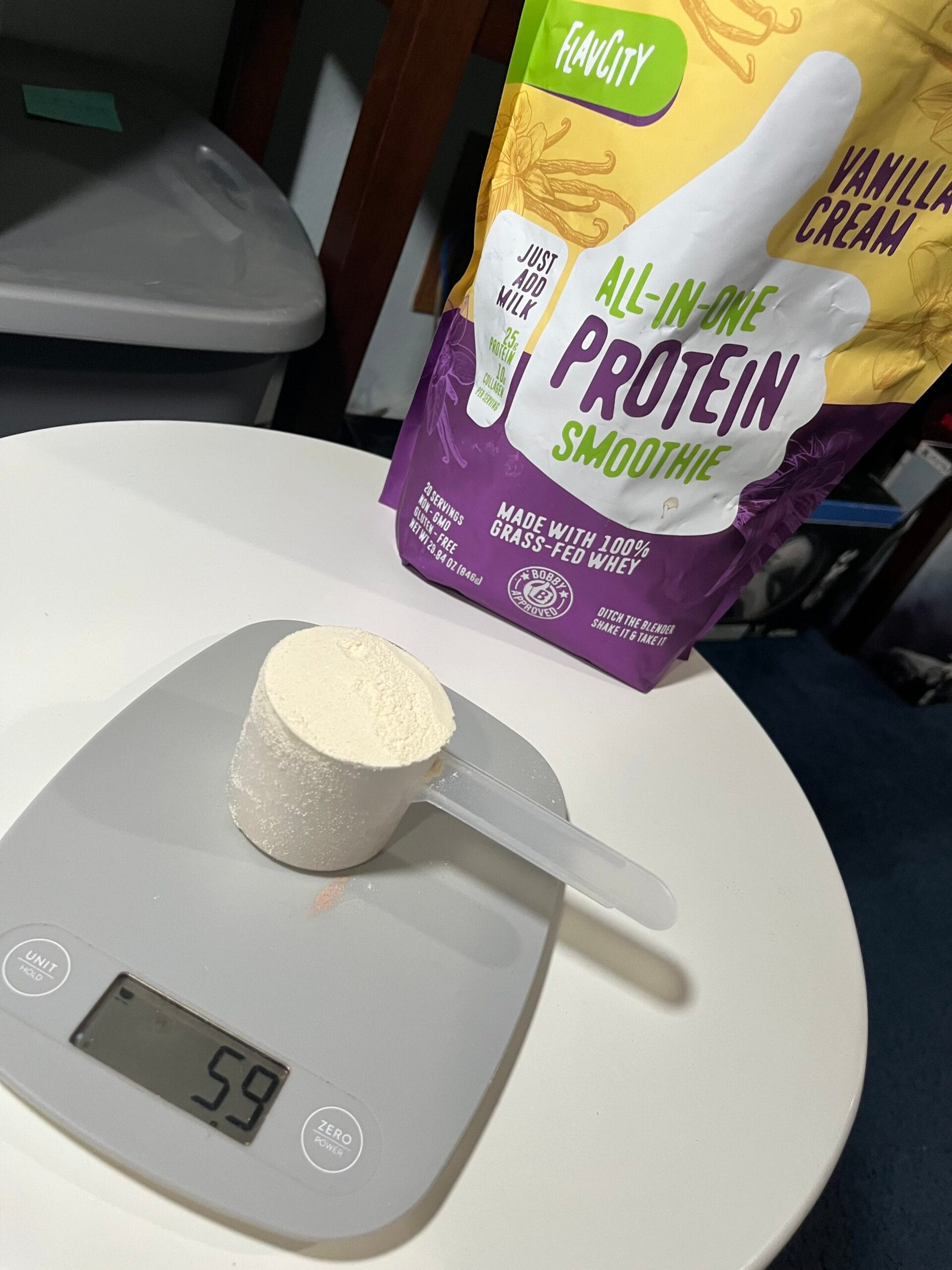
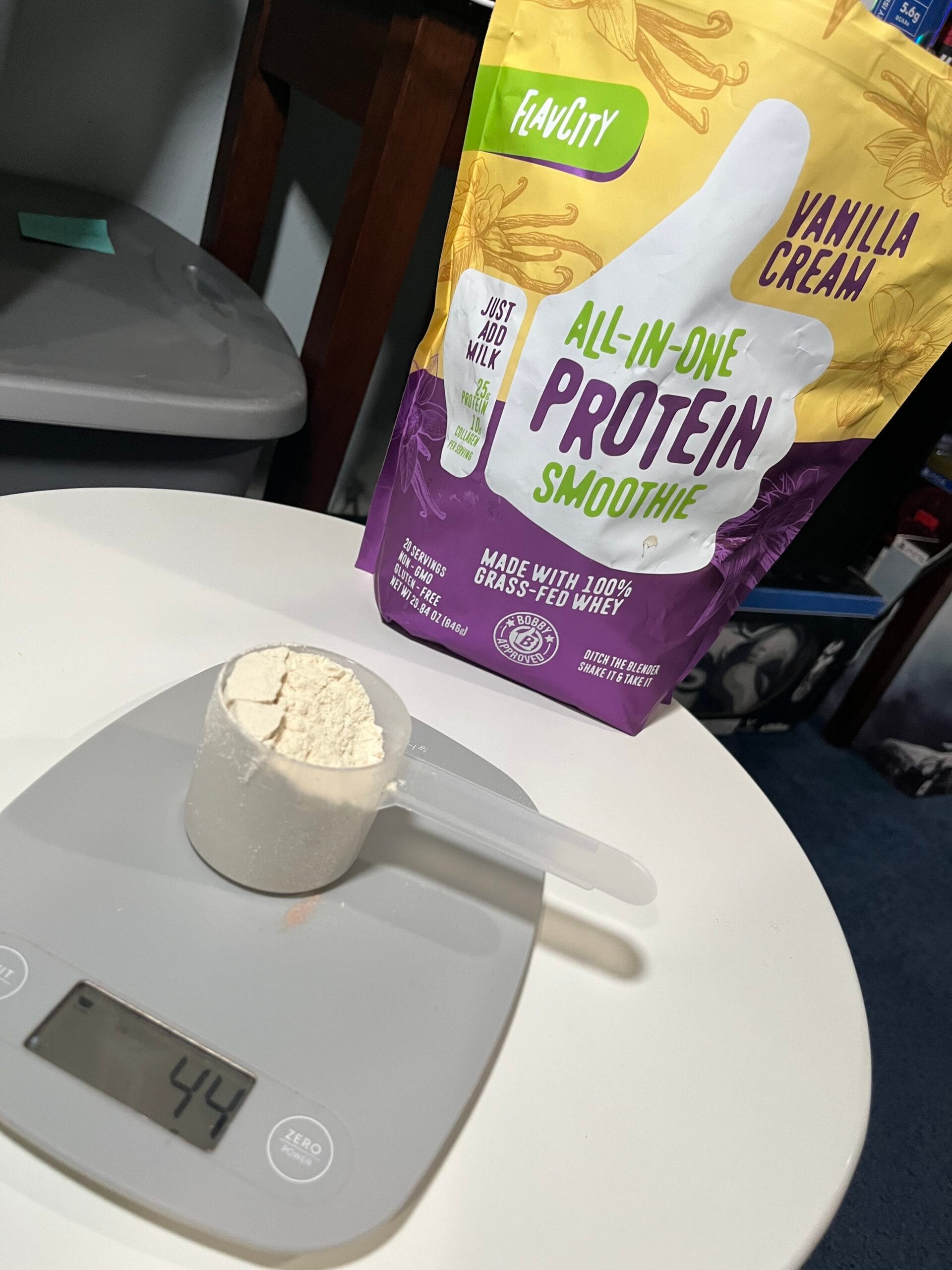
FlavCity Scoop Size
This scoop is a unit. By far the biggest I’ve seen since BSN Syntha-6, and it makes “one scoop” feel like a suggestion instead of a measurement.
FlavCity Powder behavior matches what you’d expect from a dense, all-in-one blend: it pours without drama, but it’s not airy. It packs into the scoop, settles, and doesn’t have that light, fluffy “amino dust” vibe. Translation: how you fill the scoop matters. A packed scoop vs a level scoop is not the same serving, and this formula is dense enough to make that difference real.
Here’s the problem on the old formulation: the listed serving is about three-fourths of a scoop. So if someone uses the included scoop like a normal person and fills it, they’re effectively pouring ~1.5 servings into the shaker. That’s a red flag for consistency, because serving accuracy shouldn’t depend on whether you’re a “three-quarter scoop” disciple.
To be fair, it’s very possible the newer formula corrected the scoop-to-serving alignment. In a perfect world, this mismatch would result in a point deduction. Since I’m late to the party and reviewing an older bag, giving FlavCity the benefit of the doubt is reasonable.
Verdict: The powder’s density feels intentional and consistent with the product style, but the old scoop-to-serving mismatch reads like an afterthought. If the new version fixed it, this becomes a non-issue. If not, it’s a daily dose of accidental over-serving.
FlavCity Vanilla Cream Flavor Accuracy and Drinking Experience
The aroma sets the tone before the first sip. Opening the bag hits with a light, crisp sweetness that reads more banana-forward with a coconut edge than “pure vanilla.” It’s genuinely pleasant, and it smells like something you’d actually want in a shaker, not something you tolerate because macros told you to.
The taste follows the same script. The dominant notes are banana first, coconut second, with vanilla acting more like the binder that keeps everything from tasting scattered. That matters because mushroom add-ins usually come with an earthy tax. Here, they don’t. In fact, this is one of the rare “functional” blends where the mushrooms don’t bully the flavor into tasting like forest floor tea.
Sweetness is controlled, not syrupy, and the aftertaste stays clean enough that it doesn’t feel like a budget protein doing artificial sweetener acrobatics. Mouthfeel is where the branding can get a little ahead of itself: this doesn’t drink like a vanilla milkshake. It’s thinner than that. There’s some body, but it lands more in the “healthy shake” lane than “dessert shake.”
Bottom line: the flavor experience is the product’s strongest point. It delivers an easy daily drinker that tastes better than most all-in-one powders, even if “Vanilla Cream” is really vanilla holding hands with banana and coconut.
Mixability Score: 8.5 out of 10
The powder mixes better than it has any right to, given that it’s an all-in-one smoothie protein powder that includes plant material and mushrooms. Even with water, it still shakes down into a drinkable texture with no real clumping or foaming, which proves the base formula is built to behave in a shaker, not just look good on a product page.
The only visible knock is the light particulate residue left on the shaker walls, which tracks with the banana/coconut powders and keeps it from feeling perfectly “clean” like a stripped-down protein. Real-world usability is still strong: it’s easy to make, consistent enough to repeat daily, and the minor residue is more aesthetic than performance-breaking.
Price, Value, and Availability (Short Answer)
FlavCity Protein Powder sits in the premium convenience tier at $59.99 for 20 servings, which is $2.99 per serving (subscriptions drop it to $2.69 on the FlavCity site and $2.85 on Amazon). The price is what you’re paying for the “healthy shake” experience. Still, the documentation doesn’t fully back the premium positioning: no amino acid profile or leucine disclosure, no batch-linked testing/COA receipts shown, and unanswered pre-purchase questions via the brand’s email-only support.
Availability is stable across the FlavCity website and Amazon at the same listed price, so the real differences are checkout payment options, delivery speed, and flavor appeal: Amazon is faster with Prime, FlavCity offers a bigger subscription discount and more flavor and payment options, but neither offers a true safety net.
Value verdict: inflated price for a buy-it-and-own-it smoothie replacement protein.
Where to Buy Where To Buy FlavCity Protein Powder: Retailers, Stock Status, and Buyer Protections
If you’re deciding where to buy FlavCity Protein Powder, the choice is less about price (it’s the same either way in your data) and more about shipping convenience vs. subscription value. Both the FlavCity website and Amazon list the same container price and servings, so this comes down to how you like to buy and what protections you actually get after checkout.
Amazon wins on convenience if you’re already a Prime buyer: faster shipping and a simple reorder flow. FlavCity’s site is the brand-direct lane with a slightly better subscription discount, plus Sezzle if you care about splitting payments. Neither option offers a true safety net, though. FlavCity lists no money-back guarantee, and Amazon’s “no returns on supplements” policy means once it lands, it’s basically yours forever, like a pet rock with macros.
Bottom line: if you want speed and simplicity, Amazon is the cleanest route. If you want the best subscription price and don’t care about buying direct, FlavCity’s site edges it out.
| Where to Buy FlavCity Protein Powder | ||
| Retailer | FlavCity Website | Amazon FlavCity |
| Shipping & Handling | Free S&H on orders $65+ | Prime Members get free 2-day shipping |
| Subscription Savings | 10% S&S | 5% S&S |
| Money-Back Guarantee | None | No returns on supplements |
| Payment Options | Standard payment options and Sezzle | Standard payment options |
| Price | $59.99 per container (20 servings) | $59.99 per container (20 servings) |
| Price per Serving | $2.99 (S&S $2.69) | $2.99 (S&S $2.85) |
FlavCity Return Policy, Customer Support, and Post-Purchase Risk
FlavCity’s refund policy is not a “return policy” in any normal consumer sense. It’s all sales final, with refunds explicitly off the table, and the only relief valve is shipping failure: they’ll consider replacing items that are lost or damaged in transit if the buyer emails hello@shopflavcity.com within seven days (lost) or promptly with photos (damaged). Even then, approval is “at our sole discretion,” they reserve the right to change the policy without notice, and the only scenario where a refund is mentioned is if the product is sold out after a replacement would otherwise occur.
That would still be workable if support was responsive. I sent a direct email asking for product specifics, got no reply, and that makes “all sales final” go from strict to risky. When a brand removes refunds, the minimum expectation is prompt responses before purchase and clear documentation after purchase. Silence is the opposite.
And the “small business” line doesn’t help credibility. The policy leans on that framing while the brand operates like a mass-market influencer machine (Instagram: 346k, Facebook: 5.6M, YouTube: 10.6M, TikTok: 106.1k). That mismatch matters because the stricter the policy, the more the brand needs to earn trust through clarity and support, not branding language.
Verdict: post-purchase protection is thin. This is a buy-it-and-own-it setup with a shipping-only escape hatch, and the lack of customer support responsiveness makes the risk feel structural, not incidental.
Price Breakdown and Real Value for Money
FlavCity Protein Powder sits in the premium convenience tier at $59.99 per tub (20 servings), or $2.99 per serving. Subscription pricing improves it slightly ($2.69 on the FlavCity site and $2.85 on Amazon), but it’s still priced like a smoothie replacement protein.
What that price buys, based on what’s actually shown in this review:
- Protein integrity: The formula structure looks clean and consistent with a whey protein + collagen blend. Still, there’s no amino acid profile and no leucine disclosure, so muscle-performance precision can’t be verified.
- Ingredient transparency: Strong readability. Collagen is clearly disclosed and the flavor system is listed plainly (coconut milk powder, banana powder, vanilla powder). The gaps are in the “functional” layer: no disclosed mushroom dosing or standardization, and no clarity on the certifying agent behind “organic” language when asked.
- Testing and verification: The brand uses third-party testing language online, but no batch-linked, buyer-auditable results were provided in the review evidence.
- Mixability and flavor: This is where the product earns its keep. Mixing is strong for an all-in-one smoothie powder with plant material, and Vanilla Cream is an easy daily drinker even if it reads more banana + coconut + vanilla than “pure vanilla.”
- Buyer risk: The policy reality is harsh for the price: all sales final, and email-only support that didn’t respond leaves returns and product-specific questions as dead ends.
Value verdict: inflated price.
FlavCity delivers a solid, convenient “healthy shake” experience, but the premium pricing relies more on branding than on proof. If you’re a busy parent or on-the-go buyer who cares most about taste, mixability, and a clean ingredient list, it can feel worth it. If you’re paying for verified quality, sourcing certainty, and measurable performance detail, the receipts aren’t there.
Value Score: 4.0 out of 10
FlavCity earns some value credit because the product delivers where real buyers feel it first: it tastes good, mixes well even with water, and the ingredient panel is unusually readable for an all-in-one smoothie protein powder, with collagen disclosed clearly rather than hidden. The price still doesn’t line up with what’s actually provable at checkout, since there’s no amino acid profile or leucine data and no batch-linked testing results or COA trail provided in the materials you used for the review.
Buyer protection is also weak for a premium-priced tub: the refund policy is effectively “all sales final,” and the only support channel (email) didn’t respond to basic product-specific questions. Net result: it’s a convenient, soccer-mom-friendly shake experience, but the documentation and post-purchase safety net don’t justify the premium positioning.
Brand Comparison: How It Stacks Up Against Competitors (Short Answer)
In this FlavCity Protein Powder Review, FlavCity wins on daily drinkability (mixability + flavor in a smoothie-style, all-in-one protein shake) but loses ground where serious buyers care most: proof, including missing amino data, missing buyer-auditable testing, and a harsh post-purchase safety net.
Muscle-Building Power
- Optimum Nutrition Gold Standard (Clear amino data, 24g of protein per serving, trusted for muscle-building)
- Clean Simple Eats (Could be strong for muscle-building, but lacking confirmed leucine data)
- FlavCity Protein (Good for general use, but collagen-heavy and missing key amino data and performance transparency)
- Just Ingredients (Protein-forward, but undisclosed collagen information)
- Truvani (No amino profile or leucine data; more geared toward general health than muscle recovery)
Trust & Transparency
- Truvani (USDA Organic and strong branding, but lacking full transparency with Prop 65 concerns)
- Optimum Nutrition Gold Standard (Legacy brand, however with 2025 reformulation leaves concerns about protein quality)
- Clean Simple Eats (No specific third-party certifications yet; pending re-audit in 2026)
- FlavCity Protein (No third-party certifications, Prop 65 concerns)
- Just Ingredients (No certifications mentioned, Prop 65 concerns)
Certification Strength
- Truvani (USDA Organic certification with strong branding and clean ingredients, though still lacking some proof of quality)
- Optimum Nutrition Gold Standard (Informed Choice certification, but limited to banned substance testing)
- Clean Simple Eats (No specific third-party certifications yet; pending re-audit in 2026)
- FlavCity Protein (No third-party certifications, Prop 65 concerns)
- Just Ingredients (No certifications mentioned, Prop 65 concerns)
Overal Quality
- Optimum Nutrition Gold Standard (Well-balanced protein for athletes that’s budget-forward and trusted legacy quality)
- Truvani (Good ingredient sourcing, though lack of full amino profile and Prop 65 warning hold it back)
- Clean Simple Eats (Relatively clean but needs further verification and re-audit of current protein data)
- FlavCity Protein (Strong in mixability and flavor, but lacks the transparency and proof of quality that justify its premium price)
- Just Ingredients (Great for clean shakes, but lacks transparency and has concerns with Prop 65)
Bottom Line: For muscle-building and performance needs, Optimum Nutrition Gold Standard leads the pack with proven results and affordability. If you’re after clean-label health shakes with minimal ingredients, Clean Simple Eats and Truvani could fit the bill, but their lack of transparency limits their utility for athletes. FlavCity offers a solid smoothie shake but falls short on transparency, while Just Ingredients lacks sufficient certifications and proof to justify its price.
FlavCity Protein Vs Competitors
In a FlavCity Protein Powder Review, comparisons are where the branding either holds up or collapses. A label can look clean, taste great, and still leave buyers guessing on the stuff that actually matters: what’s provable, what’s implied, and what you’re paying for.
FlavCity protein is clearly built as an all-in-one smoothie protein powder, not a precision performance product. So the point of these head-to-heads isn’t “which one tastes best.” It’s whether FlavCity’s premium price is backed by real transparency and buyer protection, or if it’s mostly clean aesthetics and influencer momentum.
Below, I’m comparing FlavCity against Just Ingredients, Clean Simple Eats, Optimum Nutrition, and Truvani based on what readers care about when money’s on the table: label clarity, verification strength, real-world usability, post-purchase risk, and whether the value matches the story.
FlavCity Protein vs Just Ingredients
FlavCity Protein and Just Ingredients both sell “clean,” but they get there in different ways. FlavCity is an all-in-one smoothie protein powder built for taste and convenience, using a whey protein + collagen structure and smoothie-base ingredients. Just Ingredients reads more like a protein-first option with tighter macros and a smaller serving footprint.
On the Just Ingredients side, the table shows a leaner nutrition panel (lower calories, very low carbs, zero sugar) and a smaller serving size, which is exactly what readers expect from a cleaner, more protein-forward daily shake.
On the FlavCity side, the final review is clear: the ingredient panel is readable and the product performs well for daily drinkability, but the proof layer is thin. There’s no published amino acid profile, no leucine or total BCAA disclosure, and no buyer-auditable COAs or batch results in the materials used for the review. You also emailed FlavCity for product specifics and received no reply, leaving readers stuck with label language rather than documentation.
Use the comparison table below for the side-by-side numbers, then jump to the full breakdown in my Just Ingredients Protein Powder review.
| FlavCity Protein vs Just Ingredients: Amino Profile and Nutrition Facts Compared | ||||
| Key Differences & Comparison Metrics | FlavCity Vanilla (New Formulation) | %DV | Just Ingredients Vanilla Bean | %DV |
| Leucine | Emailed, No Reply | Requested/Proprietary | ||
| Leucine Percent | Emailed, No Reply | Requested/Proprietary | ||
| Total BCAAs | Emailed, No Reply | Requested/Proprietary | ||
| Protein Density | 58% (Total Protein)38% (No Collagen) | 67% | ||
| Protein per Serving | 25g (16.5g with 10g Collagen) | 33% | 25g | 50% |
| Carbs per Serving | 9g | 3% | 1g | 0% |
| Fiber per Serving | <1g | 3% | 0g | 0% |
| Total Sugars | 5g | — | 0g | — |
| Calories | 160 kcal | 110 kcal | ||
| Serving Size | 43g | 29g | ||
| Number of Servings | 20 | 30 | ||
| *January, 2026 | $59.99 | $67.50 | ||
| Price per Serving | $2.00 | $2.25 | ||
| *Amazon pricing — supports my work through affiliate earnings when you shop using my link to buy Just Ingredients Protein at Amazon. | ||||
FlavCity Protein vs Clean Simple Eats
FlavCity Protein and Clean Simple Eats compete for the same buyer: someone who wants a smoothie-style protein shake that tastes good enough to repeat daily. The difference is how much of the “proof layer” is available to the public. In this FlavCity Protein Powder review, the Brand emphasizes clean-label transparency and a lifestyle positioning. At the same time, key verification points (amino profile, leucine, total BCAAs, batch-linked testing) are not evident in the review materials.
Clean Simple Eats, based on the current data used here, reads more like a traditional macro-leaning protein powder: a smaller serving size, lower calories, and a label that’s easy to compare line by line. Grass-fed claims should stay neutral in this comparison because a new Clean Simple Eats review is planned, so this section won’t over-credit anything that hasn’t been re-audited.
For FlavCity, what’s clear is what’s printed, and what’s unclear is what the brand won’t document. The final review establishes that no posted amino acid profile, no leucine disclosure, no total BCAA yield, and no third-party verification are shown in the materials used. When asked by email for product specifics, FlavCity did not respond, which matters because premium pricing works better when the brand can answer basic verification questions.
Use the table below for the cleanest side-by-side snapshot, then go deeper here: Clean Simple Eats Protein review (a new one will be published in 2026).
| FlavCity Protein vs Clean Simple Eats: Key Label and Value Differences | ||||
| Key Differences & Comparison Metrics | FlavCity Vanilla (New Formulation) | %DV | Clean Simple Eats Protein Powder Vanilla | %DV |
| Leucine | Emailed, No Reply | Unkown at this point | ||
| Leucine Percent | Emailed, No Reply | Unkown at this point | ||
| Total BCAAs | Emailed, No Reply | Unkown at this point | ||
| Protein Density | 58% (Total Protein)38% (No Collagen) | 60% | ||
| Protein per Serving | 25g (16.5g with 10g Collagen) | 33% | 20g | 40% |
| Carbs per Serving | 9g | 3% | 7g | 3% |
| Fiber per Serving | <1g | 3% | 2g | 7% |
| Total Sugars | 5g | — | 1g | — |
| Calories | 160 kcal | 110 kcal | ||
| Serving Size | 43g | 33g | ||
| Number of Servings | 20 | 30 | ||
| *January, 2026 | $59.99 | $64.99 | ||
| Price per Serving | $2.00 | $2.17 | ||
| *Amazon pricing — supports my work through affiliate earnings when you shop using my link to buy Clean Simple Eats on Amazon. | ||||
FlavCity Protein vs Optimum Nutrition
FlavCity Protein and Optimum Nutrition Gold Standard Whey serve different purposes. FlavCity positions itself as a clean-lifestyle smoothie alternative, while ON offers a legacy of consistency: known protein content, reliability, and easily verifiable third-party proof. FlavCity’s strengths are clear ingredient lists and a convenient all-in-one formula. Still, key performance details such as amino data, sourcing information, and third-party testing are missing, making it harder to fully trust the product’s muscle-building efficacy.
Optimum Nutrition stands out in the transparency department with a solid third-party certification screen for banned substances (Informed Choice) and detailed performance data, like 24g of protein per scoop and 2.6g of leucine. ON’s mixability is strong, and the product is widely available, making it a popular choice for those who value consistency. However, their labeling shift to “Natural and Artificial Flavors” raises concerns about the purity of the protein.
FlavCity’s formula shines in flavor but falls short in terms of verifiable quality. There’s no published amino acid profile, no leucine or BCAA disclosure, and no batch-linked COAs for transparency. The product also carries a Prop 65 warning narrative on the website, but there’s no stamp on the packaging. When asked for clarification, FlavCity’s lack of response falls short for a premium-priced product.
For more information, see my Optimum Nutrition 100% Gold Standard Whey Protein review.
| FlavCity Protein vs Optimum Nutrition: Side-by-Side Comparison | ||||
| Key Differences & Comparison Metrics | FlavCity Vanilla (New Formulation) | %DV | ON Gold Standard Vanilla Ice Cream | %DV |
| Leucine | Emailed, No Reply | 2.6g | ||
| Leucine Percent | Emailed, No Reply | 10.83% | ||
| Total BCAAs | Emailed, No Reply | 5.5g | ||
| Protein Density | 58% (Total Protein)38% (No Collagen) | 78% | ||
| Protein per Serving | 25g (16.5g with 10g Collagen) | 33% | 24g | 48% |
| Carbs per Serving | 9g | 3% | 5g | 2% |
| Fiber per Serving | <1g | 3% | 0g | 0% |
| Total Sugars | 5g | — | 4g | — |
| Calories | 160 kcal | 130 kcal | ||
| Serving Size | 43g | 32g | ||
| Number of Servings | 20 | 68 | ||
| *January, 2026 | $59.99 | $89.99 | ||
| Price per Serving | $2.00 | $1.34 | ||
| *Amazon pricing — supports my work through affiliate earnings when you shop using my link to buy Optimum Nutrition Gold Standard on Amazon. | ||||
FlavCity Protein vs Truvani
FlavCity Protein and Truvani occupy similar “premium” spaces in the market, both emphasizing clean ingredients and branding. Truvani markets itself as a USDA Organic, minimal-ingredient protein made with grass-fed whey, but fails to provide critical data, such as amino acid profiles and third-party testing, leaving gaps in transparency. FlavCity also leans into clean labeling, though its lack of amino profile disclosure and absence of independent verification mirrors Truvani’s stance. While both brands cater to health-conscious consumers, the difference lies in the amount of data each provides to substantiate its claims.
Truvani offers USDA Organic certification and avoids fillers and artificial sweeteners. Their simple ingredient list and minimalist approach appeal to those prioritizing clean products, but the lack of transparency regarding leucine content and other performance metrics leaves serious athletes questioning the protein’s efficacy.
FlavCity, similar to Truvani, does not provide an amino acid profile or third-party verification, and its “grass-fed” claim remains unsupported by independent certifications. However, its blend includes collagen, which may offer a slight edge in texture,. Still, the absence of critical data, like %DV or leucine content, means FlavCity falls short compared to Truvani in terms of measurable quality and transparency.
Check out my full review of Truvani Whey Protein.
| FlavCity Protein vs Truvani: Nutrition and Price Breakdown | ||||
| Key Differences & Comparison Metrics | FlavCity Vanilla (New Formulation) | %DV | Truvani Vanilla | %DV |
| Leucine | Emailed, No Reply | Requested/Proprietary | ||
| Leucine Percent | Emailed, No Reply | Requested/Proprietary | ||
| Total BCAAs | Emailed, No Reply | Requested/Proprietary | ||
| Protein Density | 58% (Total Protein)38% (No Collagen) | 74.7% | ||
| Protein per Serving | 25g (16.5g with 10g Collagen) | 33% | 20g | 40% |
| Carbs per Serving | 9g | 3% | 6g | 2% |
| Fiber per Serving | <1g | 3% | 2g | 7% |
| Total Sugars | 5g | — | <1g | — |
| Calories | 160 kcal | 100 kcal | ||
| Serving Size | 43g | 26.75g | ||
| Number of Servings | 20 | 20 | ||
| *January, 2026 | $59.99 | $59.99 | ||
| Price per Serving | $2.00 | $2.00 | ||
| *Amazon pricing — supports my work through affiliate earnings when you shop using my link to buy Truvani Whey Protein on Amazon. | ||||
FlavCity Protein Reviews: What Real Customers Are Saying On Amazon (Short Answer)
FlavCity Protein has a solid 4.5-star rating from over 3,000 buyers on Amazon, but the reviews reveal a range of experiences. Here’s a snapshot of what customers are saying:
5-Star Standouts
- “Absolutely my favorite protein powder! Most whey protein powders upset my stomach. This one does not even a little bit! This protein powder tastes really good and is very creamy.”
- “Love Bobby Approved! The vanilla FlavCity protein shake tastes great. I can definitely taste the banana and coconut in the vanilla shake. So it’s not straight vanilla flavor if that makes sense.”
- “Delicious flavor, great ingredients & quality is important to me!! Very happy with this product!!! It’s possible it may make me a bit bloated, but it definitely fills me up for the morning and has a good amount of protein & fiber. (Technically offers less than 1g of fiber, this person is on crack).”
1-Star Concerns
- “Exorbitantly overpriced. You can get clean protein and add collagen yourself on the side for way cheaper. 20 servings for $60 is robbery.” (goes back to my concern as a cash grab)
- “Oh, I had hopes for this one. Protein powder and mushrooms? But it was not to be. First I tried using it instead of my usual protein powder in my usual smoothie recipe in the blender. Bad idea. This stuff bulks up in a blender, trapping a lot of air and making the blender complain.”
- “Buyer beware! I must preface this by stating that I’ve gone through 4 bags of this protein powder since June. It tastes delicious, but the ingredients don’t sit well with me. In the beginning I was fine, but for the past month I’ve been experiencing gastrointestinal issues. Aka extreme nausea and diarrhea.” (Probably because of the Prop 65 warning not stamped on the bag)
Professional Take
The feedback is clearly divided. On one side, customers love the flavor, mixability, and creamy texture. On the other hand, the lack of transparency regarding amino acid data, the high price, and potential gastrointestinal discomfort raise major concerns. While many enjoy it for general use, the premium pricing and questionable transparency—no amino acid profile, no third-party testing—make it hard to recommend for those tracking exact protein quality.
The lack of a Prop 65 warning stamped on the bag, with drinking more than 1 daily shake may be the reason some individuals have GI issues. Simply put: If you’re paying for quality, you expect receipts. Here, you get a great-tasting smoothie base with few guarantees.
FlavCity Protein Powder Review – Final Thoughts (Before You Buy)
Before you buy FlavCity Protein Powder, here’s what actually matters:
1. Premium price for branding, not proof
You’re paying ~$3 per serving for a powder that tastes like a smoothie mix with whey + collagen, not a straight performance whey designed for muscle synthesis. The bag delivers drinkability and flavor — yes — but not the measurable performance you’d expect for the price. What’s in the bag is predominantly flavor base (coconut milk powder, banana powder), whey concentrate, collagen, and under‑specified functional add‑ins (cordyceps & reishi with no dose listed). That’s a smoothie experience, not a precision protein shake.
2. Transparency remains shallow — marketing over metrics
There’s no amino acid profile, no leucine/BCAA disclosure, and no batch‑specific third‑party lab results you can audit. The brand claims third‑party testing, but that’s ingredient testing, not finished-product verification tied to the bag you’re buying. When asked directly for specifics, the brand didn’t answer — which reinforces that what you’re getting is more “trust us” marketing than documented performance.
3. Real concerns not fully addressed
Some buyers report stomach issues with repeated use, and there’s active Prop 65 enforcement activity in the background for related products. The bag you have didn’t carry a Prop 65 warning, but the mismatch between online disclosures and actual packaging adds another layer of uncertainty. When a product is priced on the premium side, buyers reasonably expect clarity — not ambiguity.
So what are you actually getting?
- A clean‑label smoothie‑style protein that mixes well and tastes good
- Whey protein concentrate plus collagen (collagen inflates the protein number without the same muscle‑building signal as whey)
- Flavor system that reads like food (banana + coconut + vanilla)
- Functional mushrooms with no verifiable dose behind them
If your priority is taste, daily convenience, and a “healthy shake” experience, FlavCity delivers. If what you really care about is muscle‑building precision, documented amino data, batch verification, and transparent sourcing, then this product is marketed like a premium brand but doesn’t back up its claims with the documentation and metrics that justify the price. It’s a smooth, smoothie base that costs top‑tier bucks without the data to back it up.
Is FlavCity Protein Powder Good?
FlavCity Protein Powder is good for one thing: casual health shakes. It’s not good for anyone looking for a serious protein powder with verifiable data or muscle-building precision.
This protein powder presents itself as a clean, all-in-one smoothie alternative with good mixability and a delightful flavor. The major plus: it clearly lists how much collagen you’re getting per serving, which is refreshing in a world full of vague “protein blends.” There’s no secret trojan horse in “natural and artificial ingredients,” suggesting you’re getting a cleaner product overall. However, transparency issues plague it—especially concerning the grass-fed whey claim and the lack of amino acid profile or leucine/BCAA data. While the taste and mixability are decent, the product fails to justify its steep $60 price tag without any proof to back its claims, particularly given potential exposure to heavy metals linked to the ongoing Prop 65 lawsuit.
If you’re familiar with Bobby Parish or need a quick smoothie-style snack, FlavCity Protein Powder can fill that niche. It’s an easy-to-mix protein shake, better than a candy bar or chips, especially for busy parents or those on the go. But why pay $60 for a product that lacks vital transparency and could be tainted with unsafe levels of heavy metals? In the end, it’s a questionable purchase, despite the solid protein listed on the bag.
Final Score: 31/50 (62%) — Recommendation Tier: Questionable Purchase
If you’re looking for a convenient, health-conscious alternative to junk food, FlavCity might work, but you’ll pay a premium for a lot of unanswered questions. For serious muscle-building or those who demand verified quality, you should probably keep moving.
Before You Spend $60: The Truth About This “Healthy” Smoothie Powder
FlavCity Protein is a smoothie-style shake you’ll actually drink. In water, it mixes fast with only light residue, and the Vanilla Cream profile drinks more banana-coconut than dessert-vanilla. FlavCity Protein also discloses 10g collagen, so it’s not sneaky amino spiking, but there’s still no amino acid profile to verify leucine/BCAA yield. The brand claims testing, yet no batch COAs include receipts, and the Prop 65 warning language appears online, not on the bag. FlavCity Protein fits busy, health-first snackers, not performance purists.
Pros
- Great mixability and drinkability
- Collagen amount disclosed
- Clean-label feel, no artificial sweeteners
Cons
- No amino panel (leucine/BCAA unverified)
- No batch-linked COAs
- Prop 65 messaging mismatch (site vs bag)
FlavCity Protein Review Round-Up (Score Summary)
This section summarizes the key findings from the full review in a concise format.
| Category | Score |
| Amino Spiking | 6.5 out of 10 |
| Ingredient List | 6.5 out of 10 |
| Nutrition Facts | 5.5 out of 10 |
| Mixability | 8.5 out of 10 |
| Value | 4.0 out of 10 |
| Overall Score | 31/50, 62%, Questionable Purchase |
FlavCity Protein performs well in mixability and ingredient clarity but falls short in nutrition transparency and value. The lack of key data, including amino acid profiles and third-party testing, undermines its premium price tag.
Final Recommendation: Questionable Purchase.
FAQ – FlavCity Protein Powder
FlavCity Protein Powder is good for general use, offering a solid smoothie replacement experience with clear ingredient labels. However, its premium price isn’t fully justified by missing key data, such as amino acid profiles, third-party testing, and a full transparency trail.
FlavCity claims third-party testing but doesn’t provide batch-specific certificates of analysis (COAs) or verification records. While the brand promises testing for contaminants, there is no visible documentation for buyers to audit.
FlavCity Protein claims to use grass-fed whey and collagen, but there’s no verification or certification provided to confirm this. The label lists “grass-fed” but lacks independent verification, such as a certification like Truly Grass Fed.
Some users report gastrointestinal issues like nausea and diarrhea after consuming FlavCity Protein, which may be linked to unlisted heavy metals or undisclosed ingredient sensitivities. However, others note no stomach discomfort and find it easy to digest.
Yes, FlavCity Protein mixes well with water, though some light particulate residue may remain on the shaker walls due to the smoothie base ingredients. It’s not as smooth as a milkshake but still drinkable without major clumping.
FlavCity has faced Prop 65 concerns regarding potential lead and cadmium contamination in some of their products, as highlighted in 2025 legal filings. Although no Prop 65 warning appears on the packaging of some products, there is a blanket statement on the official webpage.
Yes, FlavCity Protein can be mixed with water. The powder mixes well, leaving only minor residue on the shaker walls from the smoothie ingredients, with no clumping or foam issues reported.
Conditionally healthy for the “clean smoothie replacement” crowd, but it’s not fully verifiable. The ingredient panel reads clean and avoids the usual artificial sweetener circus, and collagen is clearly disclosed. The problem is trust: there’s a blanket Proposition 65 warning on the website, but no warning on the bag you reviewed, which creates a disclosure gap buyers can’t audit at checkout. Add the missing amino acid profile and no batch-linked COAs, and “healthy” becomes a marketing vibe, not a documented standard.
Disclosure & Affiliate Information
Some links on this page may be affiliate links. If you choose to purchase through them, I may earn a small commission at no extra cost to you. That support helps keep reviews independent, evidence-driven, and free from brand influence.
Amazon Affiliate purchase links are provided below.
FlavCity, 20 servings, $59.99: https://amzn.to/4a9XHER
Just Ingredients, 30 servings, $67.50:https://amzn.to/4k2tyuH
Clean Simple Eats, 30 servings, $64.99: https://amzn.to/3LyV1aB
Optimum Nutrition, 68 servings, $89.99: https://amzn.to/3NWN6RX
Truvani Whey Protein, 20 servings, $59.99: https://amzn.to/41Fo3db
FlavCity Protein Powder Review Sources
21 CFR § 101.9 – Nutrition labeling of food. (n.d.). LII / Legal Information Institute. https://www.law.cornell.edu/cfr/text/21/101.9
Babe, M. M. F. (2022, December 22). Misinformation is not OK: An open letter to FlavCity | AGDAILY. AGDAILY. https://www.agdaily.com/insights/misinformation-not-ok-open-letter-flavcity/
Center, E. R. (2026, January 15). FlavCity Proposition 65 violations — Environmental Research Center. Environmental Research Center.
https://www.erc501c3.org/activecases/dy6c94uhmw3xpj2dohrqs0ww3vhjs1
FlavCity. (n.d.). About us | FlavCity. Shop FlavCity. https://www.shopflavcity.com/pages/about-us
Hewlings, S. J., Kalman, D. S., College of Health Sciences, Central Michigan University, Nutrasource, & College of Health Care Sciences, Nova Southeastern University. (2020). Achieving Optimal Protein Synthesis and Muscle Function: Less Processing May Be Beneficial. In Journal of Exercise and Nutrition (Vol. 3, Issue 1, p. 3) [Short Review]. https://journalofexerciseandnutrition.com/index.php/JEN/article/download/59/52
Hirsch, K. R., Smith-Ryan, A. E., Roelofs, E. J., Trexler, E. T., & Mock, M. G. (2016). Cordyceps militaris Improves Tolerance to High-Intensity Exercise After Acute and Chronic Supplementation. Journal of Dietary Supplements, 14(1), 42–53. https://doi.org/10.1080/19390211.2016.1203386
Office of Environmental Health Hazard Assessment. (2001). PROCESS FOR DEVELOPING SAFE HARBOR NUMBERS. In Reproductive and Cancer Hazard Assessment Section. https://oehha.ca.gov/sites/default/files/media/downloads/crnr/2001safeharborprocess.pdf
Oikawa, S. Y., Kamal, M. J., Webb, E. K., McGlory, C., Baker, S. K., & Phillips, S. M. (2019). Whey protein, but not collagen peptides, stimulates acute and longer-term muscle protein synthesis with and without resistance exercise in healthy older women: a randomized controlled trial. American Journal of Clinical Nutrition, 111(3), 708–718. https://doi.org/10.1093/ajcn/nqz332
Pazzi, F., Adsuar, J. C., Domínguez-Muñoz, F. J., García-Gordillo, M. A., Gusi, N., & Collado-Mateo, D. (2020). Ganoderma lucidum Effects on Mood and Health-Related Quality of Life in Women with Fibromyalgia. Healthcare, 8(4), 520. https://doi.org/10.3390/healthcare8040520
Shu, M., Zhang, X., Zuo, L., Jiang, F., Liang, J., & Li, F. (2025). Effects of fungal supplementation on endurance, immune function, and hematological profiles in adult athletes: a systematic review and meta-analysis. Frontiers in Nutrition, 12, 1670416. https://doi.org/10.3389/fnut.2025.1670416
SupplementLabTest. (2019, February 23). How is protein tested with a nitrogen and amino acid analysis? SupplementLabTest. https://www.supplementlabtest.com/articles/how-protein-tested-nitrogen-and-amino-acid-analysis
Environmental Research Center, Inc. (2025, July 15). Complaint: Environmental Research Center, Inc. v. FlavCity Corp., et al. (Case No. 25CV131519) [Civil complaint]. California Department of Justice, Office of the Attorney General.https://oag.ca.gov/system/files/prop65/complaints/2025-01316C9920.pdf

Meet James, a decade-long devotee to transforming fitness journeys, both in-person and online. As a virtual and remote personal trainer, he merges passion with expertise to deliver unparalleled fitness guidance. James isn’t just about workouts; he’s a protein powder aficionado, always on the hunt for the next best blend to enhance your gains.
Holding Bachelor’s Degrees in Exercise Sports Science and Pre-Law, James’s academic foundation is as solid as his fitness regimens. His certifications read like a who’s who of fitness excellence: NSCA (CSCS), Precision Nutrition Level 1, Online Trainer Academy (OTA), C-ISSN, and more. Whether you’re looking to overhaul your fitness routine, find the perfect protein, or navigate the intersection of wellness and law, James is your go-to guide for all things fitness.
Leave a Reply