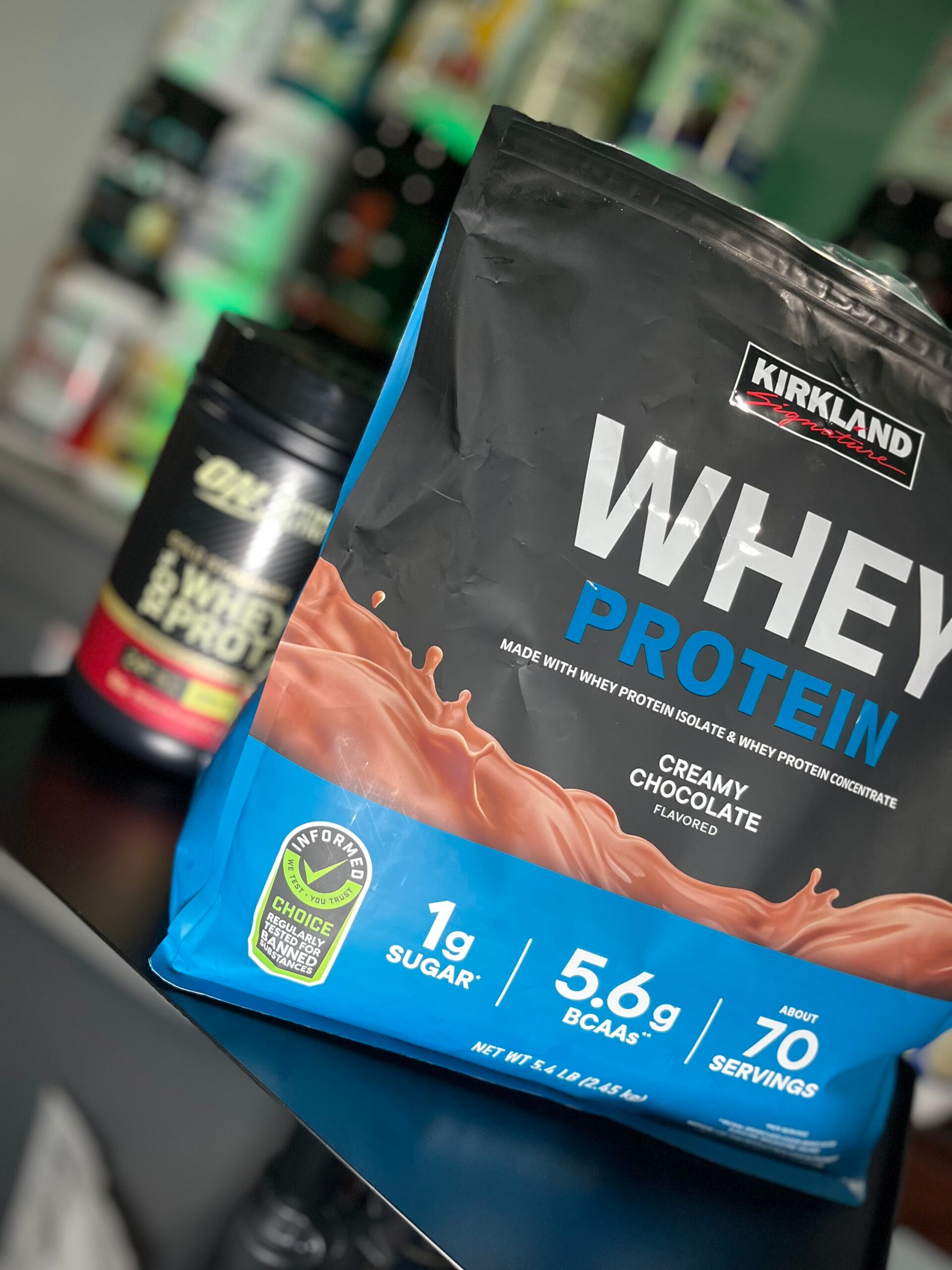
Kirkland vs Optimum Nutrition — Which Protein Powder Is Better?
People compare these two for a simple reason: they’re both “default whey” options that people buy without wanting to read a long essay. Kirkland wins on value and ease of use on a Costco scale. Optimum Nutrition wins because of its good reputation, consistent flavor, and the fact that it has been in more shaker cups than most people have owned socks.
This comparison draws on my separate reviews of Kirkland and Optimum Nutrition Gold Standard to help you feel more confident in your choice based on openness, testing credibility, protein density, and ease of use. You can still trust the full reviews for final scores and decisions. I’m using Kirkland Protein Powder vs. Optimum Nutrition to help you figure out which compromise most closely matches your needs, which will make things less confusing.
Kirkland Protein vs Gold Standard — Budget Value or Better Performance
Kirkland vs Optimum Nutrition TL;DR
Quick Answer: Which is Better, Kirkland or Optimum Nutrition?
Optimum Nutrition is the better choice on paper, given the performance data, but Kirkland offers a more budget-friendly option that mixes well and reduces post-purchase issues. If cost is a priority, you’ll feel reassured choosing Kirkland for its value.
Table of contents
- Kirkland vs Optimum Nutrition — Which Protein Powder Is Better?
- Kirkland vs Optimum Nutrition TL;DR
- How I Approach This Kirkland Protein Powder vs Optimum Nutrition Comparison
- Protein Transparency & Amino Integrity
- Does Either Brand Show Signs of Amino Spiking?
- Third-Party Testing: Who’s Actually Verified?
- Sourcing Transparency & Label Honesty
- Ingredients & Sweeteners — Clean or Just “Clean Looking?”
- Heavy Metals & Prop 65 Concerns
- Taste & Mixability — Which One Drinks Better?
- Nutrition Facts & Protein Density Comparison
- Price per Serving — Which Is the Better Value?
- Who Each Brand Is Best For
- Comparison Verdict — Which Fits Your Priorities Better?
- Kirkland Vs Optimum Nutrition Frequently Asked Questions
How I Approach This Kirkland Protein Powder vs Optimum Nutrition Comparison
This Kirkland Protein Powder vs Optimum Nutrition comparison applies the findings from my standalone reviews of each product. Those full reviews remain the source of all scores, safety conclusions, and final recommendations. If you want the complete documentation breakdown behind Kirkland, read the full Kirkland Protein Powder Review: https://jkremmerfitness.com/kirkland-protein-powder-review/
For the detailed analysis behind Optimum Nutrition’s amino disclosure, reformulation changes, and third-party framework, see the full Optimum Nutrition 100% Gold Standard Whey Protein review: https://jkremmerfitness.com/optimum-nutrition-gold-standard-review/
I’m a Certified Strength and Conditioning Specialist (NSCA) and Certified Sports Nutrition Professional (CISSN). Every comparison follows the same framework: protein density, amino transparency, third-party verification, sourcing clarity, and price relative to proof. No sponsorships. No brand scripting. Just what can be measured and documented.
You can see this same evidence-first approach on YouTube at JKremmerFitness: https://www.youtube.com/@jkremmerfitness
Some articles include affiliate links. If you use them, I may earn a small commission at no extra cost to you. That support keeps the reviews independent.
Protein Transparency & Amino Integrity
This is where the two brands’ ideas start to differ.
Kirkland shares an amino acid profile. But it’s important to ask if these products meet specific dietary restrictions, as this impacts consumer safety and trust. The label and scoop may look and taste like normal whey, but you have to assume that it acts like normal whey because the brand won’t show who makes the protein.
At least Optimum Nutrition provides some information to work with, which can help you feel more in control. There is an amino acid profile that is not on the label, and leucine is listed (2.6g per serving, with a reported leucine percentage of 10.83%). This openness can help you make a better choice, even though it isn’t specific to a batch or independently verified. It can also help you feel better about your choice.
Micro conclusion: It’s 50/50.
Does Either Brand Show Signs of Amino Spiking?
Based on the reviews, neither product gives clear, slam-dunk proof of amino spiking, but understanding what amino spiking means can help you evaluate quality. It’s important to know that amino spiking can inflate protein content claims, which affects trust in the product’s true nutritional value. Neither product provides definitive proof, so consumers should consider this when making a choice.
Kirkland: I can’t say for sure that it’s true or false. The formula looks like a regular whey blend, and the ingredient list doesn’t scream “free-form amino para.” But “without an amino disclosure or a COA, you’re still trusting that the protein is real “Natural and Artificial Flavors” appears lower on the ingredient list.
There is no direct proof of free-form amino spiking in Optimum Nutrition, and the amino layout behaves like whey. The problem is with the structure: the product uses nitrogen-based calculations without third-party verification of amino acid content, and the blend includes hydrolyzed whey protein that is not clearly described. Adding variability to the flavor-level formulation makes verification possible rather than certain.
Quick Check: Nod goes to Kirkland. Natural and Artificial Flavors appear lower on the ingredient list versus ON’s, which is in the top three.
Third-Party Testing: Who’s Actually Verified?
Kirkland has the Informed Choice certification, which means that they test for drugs that are illegal in sports. That matters to athletes who want to win. It doesn’t cover tasks such as checking protein integrity, verifying amino acid sequences, or detecting heavy metals. There are no publicly available COAs, no published heavy metals panel, and no disclosed amino acid profile to confirm protein composition independently.
Informed Choice is another brand owned by Optimum Nutrition. The company has facility-level certifications, including NSF, ISO, and BRCGS. These standards help make sure that products are safe and of good quality. This can help you feel better about the product’s safety, even if there’s no proof it’s safe for a specific batch. Both brands use certification systems that address safety and screening for banned substances, but neither provides detailed evidence of protein integrity or contaminant levels at the batch level.
Both brands use certification frameworks that cover safety systems and screening for banned substances. Neither brand offers batch-level documentation for consumers to verify protein yield or contaminant levels. The difference is in the size of the structure, not in the depth of the proof.
Sourcing Transparency & Label Honesty
Kirkland doesn’t provide much traceability. No real information about where the product came from, no named manufacturer, and no partner disclosure. The sourcing story is quiet, and when asked directly, the documentation line was treated as private.
Optimum Nutrition says it makes its products in the U.S. using parts from other countries, but it still doesn’t provide any information about where the dairy comes from, how it is sourced through co-ops, or how to trace it back to the farm level. It’s more than what Kirkland gives you, but it’s still general language instead of “here’s where your whey came from.”
Short: Kirkland doesn’t make it as clear where their products come from. Optimum Nutrition has some, but not enough, for a buyer who shops like an auditor.
Ingredients & Sweeteners — Clean or Just “Clean Looking?”
Kirkland starts with a whey base (isolate first, then concentrate) and then adds a lot of texture and “creaminess” support with fibers, gums, lecithin, oils, cocoa, and a wide range of “natural flavors.” Sucralose and Ace-K give it its sweetness. Useful, designed for large groups, and not trying to be simple.
The Optimum Nutrition formula is also engineered. It’s a blend of whey proteins, with isolate coming first, then concentrate, and finally hydrolyzed whey protein. There are “natural and artificial flavors” in the flavor system, and they seem to be among the top ingredients in many flavors. Sucralose and Ace-K are two types of sweeteners. Gums and lecithin (sunflower and/or soy, depending on the flavor) are two types of stabilizers.
If you think “clean” means fewer moving parts, then neither of these products is pure. Kirkland looks clean until you look at how much texture support is doing the work. ON looks clean and mainstream, but the flavor system is a big part of what makes it work.
Heavy Metals & Prop 65 Concerns
Kirkland: The packaging in the picture did not have a Prop 65 warning. That matters, but the bigger problem is that there isn’t any public safety documentation. There were no heavy metal results, no public toxicology report, and no COA. So instead of “here are the numbers,” you get “no warning shown.”
The container reviewed for Optimum Nutrition also doesn’t have a Prop 65 warning, which means the levels are below the levels California requires to be disclosed. The worry is that independent tests have found small amounts of heavy metals in the larger group and in other Optimum Nutrition products. Optimum Nutrition doesn’t publish batch-level heavy metal results or a public toxicology report for Gold Standard, which would help frequent users understand how much they’ve been exposed to over time.
Practical takeaway: Safety assurance based on the review data: In the context of the review, neither product has a Prop 65 warning on the package. Neither brand provides enough information about heavy metals in each batch for someone who uses the product frequently to measure their exposure rather than guess. Optimum Nutrition doesn’t publish batch-level heavy metal results or a public toxicology report for Gold Standard, which would help frequent users understand how much they’ve been exposed to over time.
Taste & Mixability — Which One Drinks Better?
Kirkland mixes better than most large tubs should. One serving in water gives you a smooth result with little foam. The biggest problem is that it clumps together a little and sticks to the walls of the shaker. When you start stacking scoops, the texture gets thicker and harder to work with.
The winner for cleaner performance is Optimum Nutrition. One scoop quickly adds water, mixes completely, and leaves no residue, grit, or foam. The Vanilla Ice Cream flavor works like a good protein powder should: it’s consistent, easy to drink, and stronger than most “budget vanilla” flavors.
Winner: Optimum Nutrition. For the price, Kirkland is very good. ON is the “no excuses” mixer.
Nutrition Facts & Protein Density Comparison
In plain English, that means that ON gives you a little more protein per gram of powder, and it does it with a smaller scoop. Kirkland is still good, but it has more “supporting cast” weight in each serving, which makes it less dense.
| Kirkland Protein Powder vs Gold Standard: Side-by-Side Comparison | ||||
| Key Differences & Comparison Metrics | Kirkland Protein Powder Creamy Chocolate | %DV | ON Gold Standard Vanilla Ice Cream | %DV |
| Leucine | 2.67g | 2.6g | ||
| Leucine Percent | 10.68% | 10.83% | ||
| Total BCAAs | 5.6g | 5.5g | ||
| Protein Density | 72% | 75% | ||
| Protein per Serving | 25g | 50% | 24g | 48% |
| Carbs per Serving | 4g | 1% | 5g | 2% |
| Fiber per Serving | 1g | 4% | 0g | 0% |
| Total Sugars | 1g | — | 4g | — |
| Calories | 130 kcal | 130 kcal | ||
| Serving Size | 35g | 32g | ||
| Number of Servings | About 70 | 68 | ||
| Amazon Price(January 2026 ) | $54.99 through Costco($69.99 Through an official 3rd-party seller) | $89.99 | ||
| Price per Serving | $1.00 | $1.34 | ||
Price per Serving — Which Is the Better Value?
If you only care about how much each scoop costs, Kirkland is the best choice. According to your table numbers, Kirkland costs about $1.00 per serving, while ON costs about $1.34 per serving. When you multiply that by months of daily use, it’s not a small gap.
But price isn’t the only thing that matters. It’s proof plus price.
Kirkland’s worth comes from Costco’s business model and buyer protection, not from paperwork. You can’t buy COAs or metals testing here. You agree to the deal and pay the transparency tax.
Optimum Nutrition is more expensive. You’re not getting proof at the batch level yet, but you’re getting legacy quality.
Value verdict: For people who want to save money first, Kirkland is the best deal. If you want established brands in the protein powder industry, ON could be the better buy.
Who Each Brand Is Best For
Kirkland Is Best For:
- Lifters on a budget who want cheap protein every day without having to drink too much
- People who care more about how easy it is to shop at Costco than about paperwork
- Anyone who wants to buy something with little risk because the store has a strong safety net
- Buyers who can handle “no amino profile, no COA, trust the label.”
Optimum Nutrition Is Best For:
- People who want a shaker that works every time without any problems
- Lifters who want to know at least some performance-related data (like leucine)
- Anyone who wants flavors to stay the same and things to be easy to use every day
- Buyers who want a structured quality system, even if proof of quality at the batch level isn’t public
Comparison Verdict — Which Fits Your Priorities Better?
Optimum Nutrition earns the higher score for a reason. It delivers a cleaner daily experience: flawless mixability, stronger flavor, and disclosed leucine per serving. It still does not provide batch-level COAs or independently verified amino documentation, but it offers more measurable information than Kirkland. The performance is predictable, and the framework behind it is established.
Kirkland wins on price efficiency. At a lower cost per serving, it delivers adequate protein and strong retailer protection through Costco. The tradeoff is transparency. There is no public COAs or heavy metals testing upon request. You’re buying value and convenience, not documentation.
The answer to the Kirkland Protein Powder vs Optimum Nutrition question is straightforward. If price and retailer safety net matter most, choose Kirkland. If mixability, consistency, and slightly stronger transparency matter more, choose Optimum Nutrition. This comparison clarifies priorities. It does not replace either a full review.
Kirkland Vs Optimum Nutrition Frequently Asked Questions
Not in general. Optimum Nutrition receives a higher score and provides more information on sourcing. If price and Costco-level buyer protection are more important to you than documentation, Kirkland may still be the better buy.
The evidence reviewed doesn’t provide direct proof of amino spiking. The protein is not verified by Informed Protein.
It has real third-party frameworks, such as Informed Choice coverage and manufacturing-level certifications. However, it does not make public batch-specific COAs or product-level protein verification for consumer audits.
Yes, it is a real whey protein product with a known leucine content and a typical whey amino acid profile. However, that amino data has not been batch-verified or independently verified.
The best nutrition. Kirkland mixes well in a big tub, but ON is cleaner, faster, and more consistent, with almost no residue or clumping.
Yes, it has Informed Choice approval for testing for banned substances. That doesn’t include receipts customers can see, such as a COA, a heavy metals panel, or a published amino acid profile.
If you’re on a budget and don’t mind trusting retailers instead of lab receipts, go with Kirkland. Optimum Nutrition is the best choice for a reliable daily experience and a little more openness, even without batch-level proof.

Meet James, a decade-long devotee to transforming fitness journeys, both in-person and online. As a virtual and remote personal trainer, he merges passion with expertise to deliver unparalleled fitness guidance. James isn’t just about workouts; he’s a protein powder aficionado, always on the hunt for the next best blend to enhance your gains.
Holding Bachelor’s Degrees in Exercise Sports Science and Pre-Law, James’s academic foundation is as solid as his fitness regimens. His certifications read like a who’s who of fitness excellence: NSCA (CSCS), Precision Nutrition Level 1, Online Trainer Academy (OTA), C-ISSN, and more. Whether you’re looking to overhaul your fitness routine, find the perfect protein, or navigate the intersection of wellness and law, James is your go-to guide for all things fitness.
Leave a Reply