
Is BodyHealth A Good Brand? A Credibility Analysis Based on Reviewed Products
Read my full BodyHealth Perfect Amino review for a breakdown of the product, the score, and how to buy it. This page is doing something else. I’m only looking at brand-level trust signals here: how honestly BodyHealth presents itself, how clearly it supports its claims, and how much of that trust story still stands once I compare the marketing to the label and the available paperwork.
What I found is not a strong trust profile. The full standalone review remains my source for product-specific scores, conclusions, and buying guidance.
TL;DR — What I Consistently See Across Reviewed Products
One thing that keeps coming up with Perfect Amino: BodyHealth is that they’re very comfortable making big performance claims based on very little math they show. The voice of marketing is strong. There is no gram-level transparency.
I keep seeing the same divide between what is clearly stated and what is left vague. It’s usually easy to find out how much to serve. It’s also easy to find the brand story. It’s harder to find the internal dose structure that would let a buyer judge an essential amino acid blend based on its effects on their body rather than on faith.
This is important to you based on what you think quality should actually mean. BodyHealth can make that case more easily if “high quality” means simple ingredients, easy mixing, and a clean-looking formula. The case weakens quickly if it requires showing leucine, demonstrating BCAA math, making COAs public, and keeping safety documents up to date across all sales channels.
How I’m Approaching the Question of Whether BodyHealth Is a Good Brand?
As a certified strength and conditioning specialist (NSCA) and sports nutrition professional (CISSN), I use the same evidence-first framework for all of my brand-level analyses. I’m not adding any new lab work or testing from outside sources here. I’m reviewing the patterns already established in my long-form protein reviews for this brand.
I don’t want to make a final decision, give a score, or offer buying advice in this article. We want to see how consistently the brand shares information, backs up its claims, and deals with the trust issues that serious buyers care about. The full standalone protein reviews still have product-specific conclusions, scores, and buying advice.
You can see this same evidence-based method in action on video by going to YouTube and watching my full supplement breakdowns and brand discussions.
There are no affiliate links or ads in this article.
Table of contents
- Is BodyHealth A Good Brand? A Credibility Analysis Based on Reviewed Products
- TL;DR — What I Consistently See Across Reviewed Products
- How I’m Approaching the Question of Whether BodyHealth Is a Good Brand?
- What I’m Looking At in This Analysis
- Transparency Signals I Keep Seeing Across Reviews
- Testing, Verification, and What Is Actually Confirmed
- Sourcing and Manufacturing Claims in Context
- Ingredient Disclosure and Formulation Consistency
- Safety, Prop 65, and Disclosure History
- How BodyHealth Compares to Other Amino Brands
- What “High Quality” and “Good” Mean Depends on the Standard
- Is BodyHealth A Good Brand?
What I’m Looking At in This Analysis
I don’t want to turn one tub of Perfect Amino powder into a courtroom drama about every BodyHealth product ever made. I’m doing something smaller than that, and to be honest, it’s more useful. I’m only looking at the credibility patterns I already found in my long-form reviews.
That means I’m sticking to the evidence that was looked at. No new lab work. No new research dump from outside. No speculative leap from “interesting” to “proven.” What matters here is how the brand handles trust signals that come up again and again, like being open about their proprietary amino blend, disclosing leucine, verifying safety paperwork, and ensuring the math behind the claims is clear enough for a serious buyer to check.
Transparency Signals I Keep Seeing Across Reviews
The biggest problem with BodyHealth’s Perfect Amino is its lack of transparency. The brand wants the formula to be judged by the story first, then by the dose given.
Perfect Amino claims to have a “99% utilization rate” and compares it to 30 grams of whey protein. Still, the label lists only 5 grams of the whole essential amino acid blend and doesn’t specify how many grams of leucine or BCAAs it contains. That matters because the leucine threshold for muscle growth is not just a fun fact. It is the part of the conversation that sets off muscle protein synthesis from a well-dressed sales pitch.
This tells me that BodyHealth likes to use performance language that sounds exact but doesn’t give the exact numbers that would let buyers check the claim for themselves. The label is easy to read. The math isn’t clear. That’s not a small detail for a pitch about how well an EAA supplement works.
Testing, Verification, and What Is Actually Confirmed
Here, the line between what is confirmed and what is claimed is very important.
What I can directly confirm is limited. BodyHealth does have some product lines that are NSF Certified for Sport. That is true, and it matters to athletes who are worried about drug testing. It lets me know that the brand can join a serious certification system whenever it wants to.
The standard Perfect Amino formula didn’t include the kind of paperwork that would make the larger trust case stronger. There was no public batch-level COA for the standard line, no public distribution of amino acids within the company, and no public document stating how many grams of leucine were in each serving. That still leaves a hole.
The same issue comes up with the bigger promises in marketing. A line can say that it is better than whey and how it is used, but the buyer is still being asked to trust a conclusion without seeing the math. For some lines, NSF Sport helps lower the risk of contamination. It doesn’t make the proprietary amino blend in the standard formula clearer.
Sourcing and Manufacturing Claims in Context
BodyHealth’s trust story is more about how the product is made than where it comes from, like dairy or food. That makes sense for an amino product that doesn’t have a set shape, but it also changes what buyers need to see. When you don’t sell plain whey isolate, you rely more on blend architecture, quality standards, and trust in the manufacturing process.
I found that the brand talks confidently about performance and use, but the story about manufacturing quality is still stronger at the message level than in the documentation for the standard line I looked at. There is no public batch-specific COA, and the company representative said that toxicology records were not open to the public. That doesn’t prove that it’s of bad quality. It does mean that brand language is doing a better job of telling the quality story than easy-to-read paperwork.
Ingredient Disclosure and Formulation Consistency
The ingredient panel is cleaner than the dosing panel. This is the polite way to say it.
The BodyHealth Perfect Amino formula is based on a proprietary amino blend and uses a simple sweetener mix of citric acid, natural flavors, stevia, monk fruit, and katemfe extract. There are no artificial colors. There is no filler parade. No fake science sprinkles added just to make the label look busy. In terms of structure, that’s cleaner than a lot of amino products.
But being simple doesn’t mean being clear. The proprietary wall still keeps the essential amino acid blend hidden, and the sweetener system gives me more information about how flavors are made than the label does about how amino acids are distributed inside. The formula looks well-controlled and planned in terms of consistency. From a disclosure point of view, it still hides the most important performance math.
Safety, Prop 65, and Disclosure History
This is when the paperwork gets weird.
The container for the Perfect Amino powder we looked at did not have a Proposition 65 warning, and BodyHealth’s website did not include a general Prop 65 warning for the product. That sounds good, but then you see California store listings that say Perfect Amino powder and tablets have Prop 65 warnings. That doesn’t look good for consistency in disclosure.
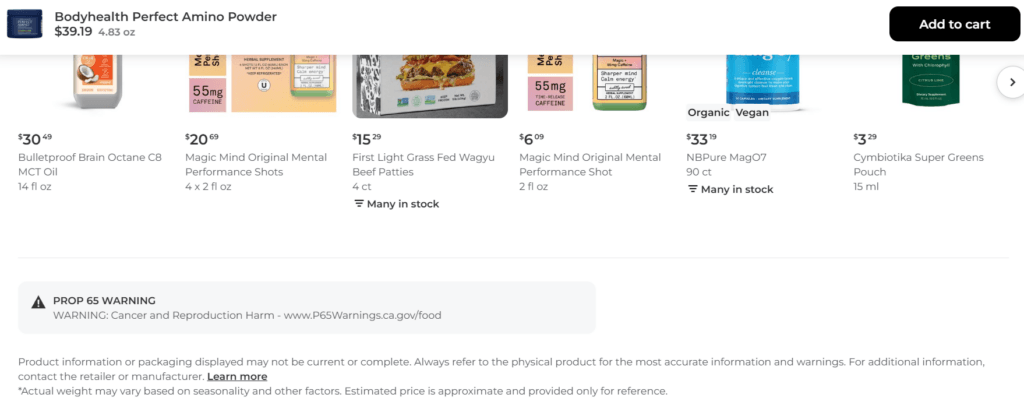
I also saw that recent 60-day Prop 65 notices listed other BodyHealth products that can be eaten as part of a larger group. Those notices are not final decisions, and they don’t say how much heavy metal is in the air. Still, they are important because they show regulatory friction around the brand portfolio, even though the product being reviewed lacks publicly available heavy metals testing or a batch-level COA.
This doesn’t mean the essential amino acid blend is dangerous on its own. It means the buyer can’t check exposure on their own, compare it to Prop 65 limits, or see how the safety story changes from one sales channel to the next. That inconsistency doesn’t help a brand that wants people to trust it.
How BodyHealth Compares to Other Amino Brands
People want to compare BodyHealth to other amino products, but the real question isn’t taste or branding; it’s how much of the formula is actually revealed. Buyers usually want to know a few specific things: how much leucine is in the product, how visible the BCAA ratio is, whether a third party has verified the product, how safe it is, and how much it costs.
The next helpful step is not which brand has the best story about how amino acids are absorbed, but which one lets you check the math without using a decoder ring and a prayer. If you care about leucine transparency and activating muscle protein synthesis, the best thing to do next is to read the side-by-side comparisons instead of just the headline claim.
Here is a list of compared brands:
- BodyHealth Perfect Amino vs Kion Aminos
- BodyHealth Perfect Amino vs Amino X
- BodyHealth Perfect Amino vs Thorne Amino Acids
- Perfect Amino Body Health vs Advanced Bionutritionals
What “High Quality” and “Good” Mean Depends on the Standard
This is where buyers often don’t understand each other.
BodyHealth can look pretty good if you think a high-quality amino brand should have a clean formula, a natural sweetener position, and a product that mixes well enough to use every day. The list of ingredients isn’t a circus, and the product’s presentation is professional.
If your standard is stricter, like clear disclosure of leucine, visible BCAA totals, public COAs, and safety documentation that doesn’t vary from store to store, the same evidence looks much weaker. It is legal to sell the product, but it can still anger a serious reviewer. Those two ideas don’t contradict each other. They are what happens when the story about the formulation is easier to see than the proof structure that goes with it.
So, when people ask whether BodyHealth amino products are “high quality” or “legit,” the answer depends largely on the standard they use. A brand can look good on the outside but still seem to lack sufficient information on safety and physiology.
Is BodyHealth A Good Brand?
Based on my review of Perfect Amino, BodyHealth is much better at telling a scientific story than proving one. I found a brand that uses a lot of performance language, selective physiology, and a polished amino story that sounds solid until you ask the simple question that any serious buyer should ask: Where is the gram-level proof?
BodyHealth wants people to believe that 5 grams can replace 30 grams of whey. They don’t show the leucine dose, the internal amino breakdown, or the batch-level paperwork that would let anyone check the claim without lighting a candle and trusting the brochure.
That is the real problem. This isn’t just a matter of not being completely open or having a few rough spots on the label. It is a brand that sells certainty by making it seem scientific, but it hasn’t fully documented it. I don’t think it’s honest to pick out a few impressive-sounding facts, wrap them in useful language, and turn them into a do-it-all performance pitch. That doesn’t make up for it, though. They just make the sales pitch look better.

Meet James, a decade-long devotee to transforming fitness journeys, both in-person and online. As a virtual and remote personal trainer, he merges passion with expertise to deliver unparalleled fitness guidance. James isn’t just about workouts; he’s a protein powder aficionado, always on the hunt for the next best blend to enhance your gains.
Holding Bachelor’s Degrees in Exercise Sports Science and Pre-Law, James’s academic foundation is as solid as his fitness regimens. His certifications read like a who’s who of fitness excellence: NSCA (CSCS), Precision Nutrition Level 1, Online Trainer Academy (OTA), C-ISSN, and more. Whether you’re looking to overhaul your fitness routine, find the perfect protein, or navigate the intersection of wellness and law, James is your go-to guide for all things fitness.
Leave a Reply