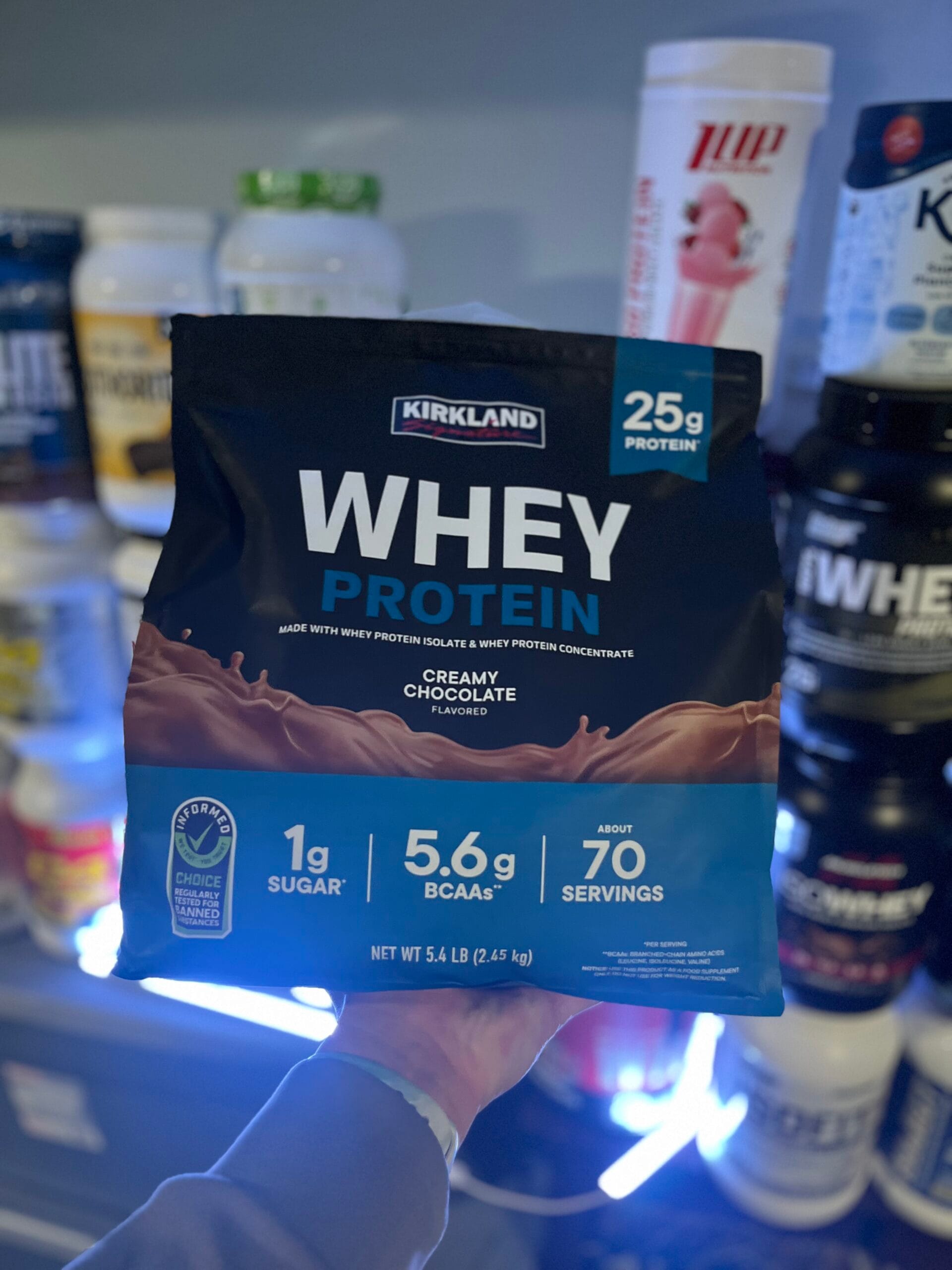
Kirkland Signature Whey Protein: Kirkland Protein Powder Review Results
If you’re buying this because it’s cheap and convenient, fair, but this review checks whether the savings come with a transparency tax you’ll actually care about.
Costco’s Best “Safe Bet” Protein… With a Transparency Tax
Summary
This Kirkland Protein Review is the definition of “works great, prove less.” You get a smooth-mixing daily whey that doesn’t foam like a science fair volcano, tastes fine, and actually fits a budget you won’t regret. The catch: no published amino acid profile, leucine is proprietary, and Kirkland wouldn’t provide a COA or heavy metals data when asked. No Prop 65 warning is shown on the bag, but that isn’t the same as documented testing. In this Kirkland Protein Review, you’re buying usability and Costco’s return safety net, not lab-level receipts. That’s the real Kirkland Protein Review verdict.
Pros
- Mixes clean
- Great value
- Amazing Kirkland Signature money-back refund policy
Cons
- No amino profile
- No public CoA or toxicology reports
- Secretive sourcing
Kirkland Protein Powder Review TL;DR
- Amino integrity can’t be verified because there’s no published amino acid profile, leucine yield is treated as proprietary, and the brand wouldn’t provide the basic receipts when asked.
- Real certification exists (Informed Choice), but it’s athlete-safety screening, not consumer-facing transparency like a COA, heavy metals panel, protein verification or batch documentation.
- The label includes protein %DV, but without validated protein quality disclosure (Informed Protein verification), it’s still nitrogen-math optics, not performance confirmation.
- Sourcing and manufacturer traceability remain undisclosed, so the “Costco value” price comes with a built-in transparency tax.
Final Score: 33.5/50 (67%) — Tough Recommendation.
Table of contents
-
Kirkland Signature Whey Protein: Kirkland Protein Powder Review Results
- Kirkland Protein Powder Review TL;DR
- Representative Review Notice
- How I Review Protein Powder
- Is Kirkland Signature Whey Protein “Costco Protein Powder” Amino Spiked? (Short Answer)
- Is Kirkland Signature Whey Protein “Costco Protein Powder” Amino Spiked?
- How Many Scoops of Kirkland Signature Whey Protein Stimulate Muscle Protein Synthesis (MPS)?
- Third-Party Testing, Safety, and Quality Verification (Short Answer)
- Is Kirkland Protein Third Party Tested? Verification Claims Explained
- Certificates of Analysis and Batch Testing: What Kirkland Publishes (and Doesn’t)
- Kirkland Protein Ingredient Accuracy, Marketing Claims, and Safety Disclosures (Short Answer)
- Kirkland Whey Sourcing: Who Makes It and Where It Comes From
- Kirkland Whey Safety Disclosures: Prop 65, Heavy Metals, COAs, and Label Gaps
- Kirkland Protein Nutrition Facts, Protein Density, and Label Integrity (Short Answer)
- Kirkland Whey Protein Density and Scoop Size Analysis
- Mixability, Texture, and Flavor Accuracy (Short Answer)
- Price, Value, and Availability (Short Answer)
- Where to Buy Kirkland Signature Protein: Retailers, Stock Status, and Buyer Protections
- Kirkland Signature Protein Comparison: How It Stacks Up Against Competitors (Short Answer)
- Amazon Reviews: What Real Customers Are Saying About Costco Protein (Short Answer)
- Kirkland Protein Review – Final Thoughts (Before You Buy)
- Kirkland Protein Powder Review Round-Up (Score Summary)
- FAQ – Kirkland Protein Powder
- Disclosure and Affiliate Information
Representative Review Notice
This review represents the complete evaluation and final verdict for Kirkland Signature Whey Protein Powder. All supporting analyses, safety breakdowns, brand-level articles, and comparison content defer to this page for scoring, conclusions, and purchase guidance.
How I Review Protein Powder
I’m a certified strength and conditioning specialist (NSCA) and sports nutrition professional (CISSN). Every protein review I publish follows the same framework: label accuracy, amino integrity, verification transparency, safety disclosures, and real-world usability.
I don’t grade based on brand reputation or influencer hype. If a protein can’t back up its claims with documentation, that gap shows up in the score, even if the shake drinks fine.
This review breaks down what Kirkland proves, what it doesn’t, and why Costco-level value and return protection still don’t replace lab-level receipts. If you want to see this framework applied on video, you can find full breakdowns and comparisons on my YouTube channel: https://www.youtube.com/@jkremmerfitness
Is Kirkland Signature Whey Protein “Costco Protein Powder” Amino Spiked? (Short Answer)
There’s no direct proof that Kirkland Signature Whey Protein is amino-spiked, but protein integrity can’t be verified because the brand won’t publish the amino acid profile or provide meaningful documentation.
- Amino acid profile disclosure is missing, so the leucine yield and total EAAs can’t be confirmed
- “Natural flavors” transparency is limited, which creates a disclosure gap in the formula’s flavor system
- The label looks clean with a whey protein isolate blend, but the verification still relies on private label manufacturing trust
- No certificate of analysis (COA) or third-party testing verification was provided when requested
Amino Spiking Score: 4/10
If you want the full evidence chain behind this Costco protein powder rating, the complete breakdown is below.
Is Kirkland Signature Whey Protein “Costco Protein Powder” Amino Spiked?
Based on the label and Kirkland’s responses, there’s no direct proof this Costco protein powder is amino spiked. The problem is simpler: Kirkland won’t provide the amino data that would confirm protein integrity, so the buyer is forced to judge it by label optics instead of verified performance.
Top-line concerns:
- No amino acid profile provided, even after requesting it directly
- “Natural flavors” hides the flavor system, which limits ingredient-level clarity
- Transparency stops at the marketing claims, with no documentation to back them up
No Amino Acid Profile = No Protein Integrity Verification
Kirkland does not publish a full amino acid profile for this product. When contacted, they said they would share amino information if it was available, but no profile was provided. Without that data, you can’t verify leucine yield, total EAAs, or whether the 5.6g BCAA claim matches standard whey behavior.
“Natural Flavors” Creates a Disclosure Gap
The label relies on “natural flavors,” which is intentionally broad and doesn’t require the company to disclose what’s inside the flavor system. Kirkland also wouldn’t clarify what that blend includes beyond the ingredient panel. This doesn’t prove amino spiking, but it does reduce transparency and makes verification harder than it needs to be.
Clean Label Optics Without Receipts
On paper, Costco Kirkland protein powder looks like a quality whey formula: whey protein isolate leads the label, whey concentrate backs it up, and the rest of the deck reads like a bulk-friendly blend built to mix well and look clean. The bag also leans hard into credibility claims like gluten-free, non-GMO, no soy ingredients, and no milk from rBST-treated cows, which is exactly how a private-label protein is supposed to present at Costco. The issue is that Kirkland refused to disclose who manufactures it or provide an amino acid profile, so Kirkland protein powder quality can’t be verified beyond label claims, and the final rating ends up being trust-based rather than evidence-based.
Kirkland Signature Whey Protein Offers No Publicly Available Amino Acid Profile = No Protein Integrity Verification
No, I can’t verify protein integrity with confidence here, because Kirkland Signature Whey Protein does not publish a full amino acid profile and did not provide one when requested, which means performance-critical metrics like leucine yield and total EAAs are guesswork, not confirmed data. Under 21 CFR §101.36(b)(2)(i), protein quality disclosure is only meaningful when it’s supported by validated testing, and Kirkland isn’t providing the underlying documentation that would make their protein claims verifiable.
- Kirkland does not publish a full amino acid profile for this product, and none was provided upon request
- The label advertises 5.6g BCAAs per serving, but there is no published leucine or EAA breakdown to confirm standard whey ratios
- The protein blend lists whey protein isolate first, followed by whey concentrate, but the integrity of that blend can’t be confirmed without amino disclosure
Why this matters: If you’re buying this for muscle-building, you can’t reliably determine whether one scoop hits meaningful MPS thresholds or if you need to overcompensate.
Kirkland Signature Whey Protein Creamy Chocolate “Natural Flavors” System = Legal Umbrella, Not Ingredient Transparency
No, this still doesn’t prove amino spiking, but it does raise the risk of undisclosed formulation components because “natural flavors” is a legally broad category that does not require ingredient-level breakdown. The FDA explicitly defines natural flavor as substances like “essential oil, oleoresin, essence or extractive” under 21 CFR §101.22, which gives brands room to keep the flavor system opaque, even when functional ingredients are involved.
- The ingredient panel lists “natural flavors” without specifying what’s inside the blend
- Amino acids like glycine can be used in food systems for sweetness/mouthfeel and are also commonly associated with low-cost protein manipulation in the supplement world
- Kirkland refused to provide an amino acid profile, so there’s no published data to verify whether the protein’s amino “fingerprint” matches standard whey
Why this matters: If amino disclosure is missing and the flavor system is a black box, you’re not verifying protein integrity, you’re trusting label presentation. That said, Costco’s flavor system sits in the bottom third of the ingredient list, which usually means the formula is still being carried by actual whey, not a heavy-handed flavor-and-filler cocktail.
Costco Kirkland Protein Powder’s Clean Label Marketing Without Manufacturing Proof
No, this doesn’t prove the Costco Kirkland protein powder is amino spiked, but it does show why verification still collapses into trust: the bag includes a protein %DV, yet Kirkland won’t provide the documentation that explains what that %DV is actually built on. The FDA’s own labeling language allows protein to be calculated from nitrogen because “protein content may be calculated on the basis of 6.25 times the nitrogen content” under 21 CFR §101.9(c)(7), which is fine in theory, but becomes a buyer problem when the brand refuses to disclose amino data that would validate real-world protein integrity.
- The formula leads with whey protein isolate, followed by whey concentrate, which gives whey Kirkland protein powder strong quality optics on paper
- The label includes a protein %DV, signaling the brand is presenting protein as a standardized nutrition value, not just a marketing number
- Kirkland refused to provide manufacturer details or an amino acid profile, so your Kirkland protein powder rating is still based on label presentation instead of independently verifiable quality
Why this matters: When the protein math is ultimately built on nitrogen-based calculation and the brand won’t show amino receipts, you’re buying Costco confidence and hoping the tub matches the label.
How Many Scoops of Kirkland Signature Whey Protein Stimulate Muscle Protein Synthesis (MPS)?
Most lifters can treat this as a one-scoop protein for post-workout MPS, assuming Kirkland’s amino profile behaves like standard whey. That assumption is the problem, not the scoop count.
Research is pretty consistent that you don’t need a heroic amount of whey to hit peak stimulation. In trained young men, “a 20-g dose of whey protein is sufficient for the maximal stimulation” of myofibrillar MPS. And in the Churchward-Venne protocol, the reference whey dose was “25 g containing ∼3.0 g of leucine”, which is exactly why that 25g serving size is usually enough on paper.
Here’s the catch: Kirkland won’t publish the amino acid profile or leucine content, so we can’t confirm whether one scoop delivers the typical ~2–3g leucine “trigger” you’d expect from a legit whey product.
3-bullet reality check (Kirkland edition):
- What we know: one serving gives 25g protein and claims 5.6g BCAAs (so it looks like normal whey behavior).
- What we can’t verify: leucine per scoop, total EAAs, and whether the BCAA number matches real whey protein structure (because there’s no amino profile).
- What you should do post-workout: run one scoop, and if you’re trying to be performance-precise instead of vibe-based, pair it with a known leucine-rich protein source to close the verification gap.
Practical prescription: One scoop is probably enough. If you don’t like “probably,” mix it with high-protein skim milk. USDA food data puts that at roughly 1.3g of leucine per serving, giving you a real leucine bump without needing Kirkland to show receipts.
Amino Spiking Score: 4 out of 10
Kirkland doesn’t show direct amino spiking red flags on the ingredient panel, and the protein base reads as a normal whey blend with isolate leading the formula. The problem is that none of the performance-critical proof is available because the brand refused to provide an amino acid profile or disclose leucine yield when asked.
“Natural flavors” also creates a built-in disclosure gap that doesn’t confirm manipulation but does make verification harder than it needs to be. In real-world terms, this becomes a trust-based purchase, where you can’t confidently validate MPS expectations from a single scoop without pairing it with a known leucine source.
Third-Party Testing, Safety, and Quality Verification (Short Answer)
Yes, Kirkland Protein Powder has legitimate third-party verification through Informed Choice/Informed Sport, but it’s athlete-safety screening, not full consumer transparency. There’s no publicly available COA or batch testing documentation, and Kirkland refused to provide an amino acid profile, heavy metal results, or manufacturer disclosure when asked. The label carries plenty of “clean” positioning, but the supporting receipts remain proprietary, limiting how confidently buyers can verify protein integrity beyond label claims.
Transparency verdict: Real certification exists, but the proof stops where consumers actually need it.
Is Kirkland Protein Third Party Tested? Verification Claims Explained
Yes, Kirkland Signature Whey Protein has third-party verification, but it’s not the “full transparency” kind most buyers are looking for. The clearest public proof is that Kirkland Signature Whey Protein (Creamy Chocolate) appears in the Informed Choice certified supplement database with a listed certification date, which confirms real program participation.
What that verification actually covers is important: Informed Choice / Informed Sport focuses on banned-substance screening and athlete safety, not publishing consumer-facing proof like amino profiles, heavy metal panels, or batch-level COAs. And when I contacted Kirkland directly at 1-800-433-1213, the rep reinforced the same boundary line: key documentation was treated as proprietary. They would not disclose who verifies the organic ingredients, provide support for the rBST-free sourcing claim, or share a Certificate of Analysis. The only claim they were willing to confirm verbally was gluten-free, but that’s still not the same as full formulation or facility disclosure.
It’s also worth noting what isn’t present. Despite the product having an “NSF-style” clean-label presentation, there’s no public NSF Certified for Sport listing for Kirkland Signature Whey Protein, and there’s no publicly available amino verification through an Informed Protein-type program.
Verdict: The testing is legitimate, but the transparency is incomplete. You get athlete-safety screening, while the core protein integrity receipts (amino profile, COA, metals data, manufacturer disclosure) remain unavailable.
Certificates of Analysis and Batch Testing: What Kirkland Publishes (and Doesn’t)
Kirkland doesn’t publish a public Certificate of Analysis (COA) page for this product, and when I contacted the brand directly, they refused to provide a COA, calling the information proprietary. That means there’s no batch-level document a buyer can reference to confirm what’s actually in the bag beyond the nutrition label and marketing claims.
The same wall goes up for the datapoints that matter most for protein integrity. Kirkland would not provide a full amino acid profile, would not disclose heavy metal testing results, and wouldn’t identify the manufacturer behind the Kirkland label. Even the “organic ingredients” verification was treated as proprietary when asked, which turns what should be a simple documentation check into a trust exercise.
This is where the transparency gap becomes measurable: without COAs or batch-testing data, there’s no way to verify whether the claimed 25g protein per serving performs like standard whey in leucine yield, EAAs, or batch-to-batch consistency. You can still buy it and get a perfectly normal whey product. You just can’t prove it, because the brand won’t hand over anything that would let you audit it.
Verdict: Kirkland gestures toward quality, but it doesn’t practice real transparency. No COAs, no batch testing documentation, and no amino verification means the product is judged by label optics, not evidence.
Kirkland Protein Ingredient Accuracy, Marketing Claims, and Safety Disclosures (Short Answer)
This section audits what Kirkland claims on the bag versus what can actually be verified, including ingredient transparency, grass-fed sourcing proof, and safety disclosures like Prop 65. The label looks clean, but the missing COA, metals data, and manufacturer disclosure keep it in the “trust the branding” lane.
Kirkland Protein Powder Ingredients Overview
Kirkland Protein Powder uses a familiar whey foundation: whey protein isolate is listed first, followed by whey protein concentrate, which reads like a standard “taste + performance” blend. Isolate gives it the premium optics, while concentrate is commonly used to support a smoother drinking experience without turning the shake into thin cocoa water.
From there, the rest of the ingredient list is clearly built around flavor and texture performance. You’ve got alkalized cocoa for the chocolate base, plus natural flavors to round out the finished profile. For thickness and consistency, Kirkland stacks multiple texture agents, including organic acacia, oat bran fiber, organic guar gum, and xanthan gum, which explains why this formula is designed to drink “creamy” instead of watery.
Mixability support shows up through organic sunflower lecithin, while organic high oleic sunflower oil helps contribute to mouthfeel. Sweetness is handled with the classic zero-calorie duo of sucralose and acesulfame potassium (Ace-K). The ingredient list also includes a small amount of whey protein hydrolysate (less than 2%), plus functional supporting ingredients like sea salt, organic rice dextrin, and organic rosemary extract.
Takeaway: This ingredient panel reads like a Costco-style formula built to do three things well: deliver whey up front, taste like chocolate, and mix smoothly without grit or separation.
| Kirkland Protein Powder Ingredients Explained in Plain English | |
| Ingredient | Purpose |
| Whey Protein Isolate | Primary protein source. Higher protein density, usually lower lactose and fat than concentrate. |
| Whey Protein Concentrate | Adds protein while improving taste/creaminess and lowering cost vs 100% isolate formulas. |
| Alkalized Cocoa | Chocolate flavor + darker color. “Alkalized” reduces bitterness and sharp cocoa acidity. |
| Organic Acacia (Acacia Fiber) | Soluble fiber used to improve texture, mixability, and mouthfeel. |
| Whey Protein Hydrolysate (less than 2%) | Pre-digested whey fraction used for marketing/fast-digest positioning and to support texture blending. |
| Oat Bran Fiber | Adds fiber and thickness. Helps the shake feel less watery. |
| Organic High Oleic Sunflower Oil | Adds creaminess and mouthfeel (helps the “creamy” part feel real). |
| Organic Sunflower Lecithin | Emulsifier that improves mixability and reduces clumping (classic “shake-friendly” ingredient). |
| Sea Salt | Enhances chocolate flavor and balances sweetness. |
| Natural Flavors | Flavor system umbrella term used to create the finished taste profile without disclosing the exact components. |
| Organic Rice Dextrin | Carrier/bulking ingredient used to support flavor distribution and powder flow. |
| Organic Rosemary Extract | Antioxidant preservative function (helps protect fats/oils from going stale). |
| Organic Guar Gum | Thickener/stabilizer used for creamier texture and better suspension. |
| Sucralose | Zero-calorie sweetener used to boost sweetness without adding sugar. |
| Acesulfame Potassium (Ace-K) | High-intensity sweetener often paired with sucralose to sharpen sweetness and reduce aftertaste. |
| Xanthan Gum | Thickener/stabilizer that improves texture and reduces separation over time. |
Kirkland Protein Label Transparency: Flavors, Additives, and What’s Not Disclosed
The Kirkland Protein Powder label mostly matches what the bag is trying to sell you: a clean-looking whey with bulk-retailer simplicity. The ingredient panel leads with whey protein isolate, then whey protein concentrate, which supports the “quality whey base” positioning right out of the gate. From there, the rest of the list is straightforward: alkalized cocoa for the chocolate profile, and a familiar lineup of texture and mixability support ingredients that are common in smoother, creamier powders.
Where the label becomes less transparent isn’t in the additives, it’s in the umbrella language. “Natural flavors” is the biggest example. It’s legal labeling, but it’s also a catch-all category that tells you flavoring exists without explaining what’s inside the flavor blend. That’s not a red flag by itself, but it does create a disclosure gap between what the bag implies and what the ingredient list can actually confirm.
On the additive side, Kirkland is surprisingly open. You can see exactly what’s being used to improve texture and keep the shake consistent: organic acacia, oat bran fiber, organic guar gum, xanthan gum, organic sunflower lecithin, high oleic sunflower oil, organic rice dextrin, and organic rosemary extract. That’s one of the few claims on the bag that the ingredient list actually backs up cleanly: No artificial preservatives.
The one area where the label leans more on positioning than proof is the organic framing. Organic ingredients are referenced, but the ingredient list itself doesn’t identify a certifying body, so the claim sits as a marketing signal rather than something the label independently documents.
Takeaway: This label is clean and readable, but not fully transparent. It supports the product’s “quality whey” presentation while keeping the flavor system and organic verification in the trust-first category rather than the proof-first category.
Kirkland Whey Sourcing: Who Makes It and Where It Comes From
Kirkland doesn’t provide real sourcing traceability for this bag. There’s no country-of-origin statement, no dairy co-op reference, no processing plant disclosure, and no partner manufacturer named anywhere on the packaging. So the specificity here isn’t “state-level” or “region-level.” It’s completely vague because the label never even tries to answer the “where is this made?” question.
And just to tighten one important point: the absence of an “internationally sourced” statement doesn’t confirm everything is U.S.-sourced. It only confirms the label isn’t volunteering sourcing details either way. When I called Kirkland at 1-800-433-1213, the rep backed that up by treating sourcing and verification as proprietary, including who verifies the organic positioning and who manufactures the product.
That sourcing silence also aligns with the broader documentation pattern in this review: no COA, no amino acid profile, and no verifiable trail linking the label to batch-level proof.
Punchline: Kirkland doesn’t tell you where the protein comes from. It just hopes you won’t ask.
Kirkland Whey Safety Disclosures: Prop 65, Heavy Metals, COAs, and Label Gaps
If you’re looking for hard safety documentation on Kirkland Signature Whey Protein, this is where the “Costco confidence” vibe runs into a wall. The bag reads clean, but the brand doesn’t publish the receipts that would let a buyer independently verify purity, contaminants, or batch consistency.
Prop 65 status (what the bag actually shows): There is no visible Proposition 65 warning on the bag panels shown. That matters because Prop 65 warnings are legal disclosures triggered when a product can expose consumers to listed chemicals above California’s “safe harbor” thresholds, including NSRL (cancer risk disclosure) and MADL (reproductive harm disclosure). No warning does not automatically mean the product was tested clean, but it does mean no California-required disclosure is shown on the packaging.
That absence would carry more weight if supporting safety documentation existed. When Kirkland was contacted directly, the representative stated a toxicology report was not available for public viewing. So the bag avoids a Prop 65 flag, but it also doesn’t provide public proof that heavy metal exposure has been evaluated and cleared.
Heavy metals testing + COA availability: Kirkland would not provide heavy metal testing results and refused to provide a Certificate of Analysis (COA) when asked, calling both proprietary. Without batch-level documentation, the only thing left to rely on is the Nutrition Facts panel and marketing claims, with no independent way to confirm what’s actually in the bag.
Protein claim verification gap: The Nutrition Facts panel lists 25g protein per serving, and the brand advertises 5.6g BCAAs, but Kirkland would not provide an amino acid profile or disclose the manufacturer. That removes the most basic protein integrity check available to consumers: verifying whether the amino “fingerprint” matches standard whey behavior and expected leucine/EAA ratios.
Sourcing + organic verification gaps: Kirkland also would not disclose who certifies the organic ingredients, would not provide documentation supporting the rBST-free claim, and would not identify the manufacturing location. The only claim the representative confirmed verbally was gluten-free, which may be true, but it still does not substitute for third-party contaminant documentation or formulation-level verification.
Verdict: Kirkland doesn’t prove safety and quality through documentation. The label looks clean and compliant, but the core verification receipts (COA, heavy metal testing, amino profile, manufacturer disclosure) remain inaccessible, making this a trust-based product instead of an auditable one.
Ingredients Score: 6 out of 10
The ingredient list looks like a legitimate Costco-friendly whey blend: whey protein isolate leads the formula, whey concentrate supports it, and the rest of the panel is a standard mix of cocoa, fibers, lecithin, oils, and gums built to deliver a smooth “creamy chocolate” shake. It also supports several of the bag’s clean-label positioning, including no soy ingredients and no artificial preservatives based on what’s actually listed.
The downside is that transparency still stops at the ingredient panel, with “natural flavors” functioning as an umbrella term and the organic positioning lacking clear, label-level verification. Overall, the formula reads solid for real-world usability, but it doesn’t provide enough specificity to earn full trust on paper.
Kirkland Protein Nutrition Facts, Protein Density, and Label Integrity (Short Answer)
From a label-math perspective, Kirkland’s Nutrition Facts panel mostly behaves like a standard whey blend: 130 calories for 25g protein with modest carbs and fat. The macro math checks out within normal rounding tolerance (25g protein = 100 calories, 4g carbs = 16, 2g fat = 18), which lands slightly above 130 on paper, but that’s exactly how supplement labels usually round and report totals.
What’s more interesting is what the panel implies versus what the brand proves. The bag includes a protein %DV presentation, but most of the industry still gets that number the old-fashioned way: nitrogen-based protein calculation (Kjeldahl-style testing), where protein is estimated from total nitrogen rather than confirmed through a published amino acid breakdown. That matters because under 21 CFR §101.36(b)(2)(i), protein %DV only carries real weight when protein quality has been validated (PDCAAS or equivalent). So even if Kirkland’s protein math is compliant, the panel still can’t confirm the performance-critical part without receipts: leucine yield, total EAAs, and whether the “5.6g BCAAs” claim matches standard whey ratios.
Mineral DVs look clean and plausible (sodium at 7%, calcium at 10%, potassium at 6%), and nothing here screams “label chaos.” The bigger limitation is the same recurring theme: BCAAs are advertised (5.6g), leucine is proprietary, and the amino fingerprint can’t be audited.
| Kirkland Protein Powder Nutrition Facts: Creamy Chocolate | ||||||||
| Nutrients | Amount per Serving (35g) | % Daily Value (%DV) | ||||||
| Calories | 130 | — | ||||||
| Total Fat | 2g | 3% | ||||||
| Sodium (mg) | 170mg | 7% | ||||||
| Total Carbohydrates (g) | 4g | 1% | ||||||
| Dietary Fiber (g) | 1g | 4% | ||||||
| Total Sugar (g) | 1g | — | ||||||
| Leucine (g) | Requested/Proprietary | — | ||||||
| Total BCAAs | 5.6g | — | ||||||
| Calcium (mg) | 130mg | 10% | ||||||
| Potassium (mg) | 260mg | 6% | ||||||
| Iron (mg) | 1.1mg | 6% | ||||||
Kirkland Whey Protein Density and Scoop Size Analysis
Protein density is one of the fastest ways to sanity-check a label. It doesn’t prove “high quality” on its own, but it does tell you whether the formula behaves like the type of protein it’s pretending to be. A true whey isolate usually lands in the high-80s to low-90s for protein percentage per serving, while blends (isolate + concentrate + flavor support) typically live a little lower because carbs, fats, fibers, oils, and gums take up real space in the scoop.
That’s why scoop weight matters. The bigger the serving size, the easier it is to make the protein number look impressive without actually delivering isolate-level density. Here, Kirkland’s chocolate serving comes in at 31g per scoop with 26g of protein, which calculates out to 84% protein density. For a blend that includes cocoa, fibers, sweeteners, lecithin, and oil, that number is believable. It’s not “clinical isolate purity,” but it also isn’t a fluffy dessert powder pretending to be performance nutrition.
| Kirkland Whey Protein Density Table | |||
| Flavor | Protein per Serving (g) | Scoop Size(g) | Protein Percentage(%) |
| Chocolate | 26g | 31g | 84% |
| Average Protein Percent for Kirkland Whey: 84% | |||
Here’s the limitation: 84% only means something if the protein is what the label says it is. Kirkland doesn’t publish an amino acid profile, doesn’t disclose leucine per serving, and wouldn’t provide verification when contacted. So the density looks credible, but it can’t be independently confirmed through the most obvious integrity check, which is whether the amino “fingerprint” matches standard whey ratios.
Verdict: The protein density helps Kirkland’s credibility on paper, but the lack of amino disclosure keeps it from being a true proof point. The number looks right. The documentation still doesn’t exist.
Does Kirkland Whey Have Any Label Changes and Consistency Issues?
For Kirkland Signature Whey Protein, there aren’t verified “old vs. new” label versions available in this review to compare side-by-side. So instead of pretending we can audit a reformulation timeline, the real consistency check becomes simpler: can the current label be independently verified across batches?
Right now, that answer is limited. The bag provides a Nutrition Facts panel and clean-label positioning, but Kirkland would not provide a COA, heavy metal testing, an amino acid profile, or manufacturer disclosure when contacted. Without those receipts, there’s no practical way to confirm whether scoop weight, macro math, mineral values, or protein integrity stay stable from one production run to the next.
Verdict: No visible label-change red flags here, but the lack of batch-level documentation means consistency can’t be confirmed beyond the packaging itself, which keeps this product in the “trust-based” category.
Nutrition Label Score: 7.5 out of 10
The Nutrition Facts panel earns credit because the macro math is clean, the serving size is clearly stated, and the label presents a believable whey layout that matches how most reputable blends are built. It also includes a protein %DV presentation, which signals the brand is at least treating protein like a standardized nutrition value rather than a vague “trust us” number.
Where it loses authority is verification. Kirkland won’t publish an amino acid profile or leucine yield, and they refused to provide a COA or batch documentation when asked, so the panel can’t confirm the performance-critical part of the protein claim beyond surface-level compliance.
And while the protein density looks strong on paper, that metric carries less weight once you compare it to verified whey standards like AGN Roots, where amino integrity is actually documented. In other words: the label reads solid, but the proof doesn’t scale with the confidence it’s trying to project.
Mixability, Texture, and Flavor Accuracy (Short Answer)
Mixing behavior: Kirkland mixes better than most bulk tubs have any right to. One scoop in water turns into a smooth shake without the foam-party aftermath, and you’re not left fishing out gritty leftovers. The only annoyance is a few small clumps that cling to the shaker walls, not your mouth.
Texture: Smooth, slightly thick, and genuinely “creamy” for a Costco blend. No sandy feel, no chalky drag, and it drinks like a normal whey should. It only starts getting stubborn if you try stacking scoops like you’re training for a protein-eating contest.
Flavor accuracy vs marketing: The smell promises chocolate dessert. The taste delivers “decent chocolate whey” and stops there. It’s drinkable, controlled on sweetness, and won’t offend you… but it also won’t make you excited to do this for 70 servings straight.
Verdict: The experience absolutely matches the price, even if the flavor is more practical than thrilling.
Kirkland Mixability Performance Test
Kirkland Signature Whey Protein mixes cleaner than most bulk-style powders, especially in plain water. It doesn’t foam up like a chemistry experiment, and the shake itself comes out smooth with no gritty sludge sitting at the bottom. The only real mixability “issue” is minor: a few small clumps can stick to the inside of the shaker cup, but they don’t clog the pour spout and they don’t end up floating in the drink.
If you follow the bag directions, it’s basically a hassle-free shake. Where it starts to get annoying is when you push it past the standard serving, because the formula gets thicker and harder to fully disperse, which turns “easy mix” into “shake harder than necessary.”
Verdict: The texture and mixability perform like a quality Costco-friendly whey blend, not a finicky bargain powder. This is genuinely good mixing at one serving, and only becomes “good enough” when you try to stack scoops.
Costco Protein Scoop Size, Density, and Pourability
Kirkland’s powder behaves exactly like what it’s trying to be: a normal, bulk-friendly whey blend that pours clean and doesn’t act like it needs a lab coat to manage. One scoop equals one serving at 35g, and the powder has a slightly “moist” look and feel, not in a sketchy way, but in the way a well-formulated protein tends to handle when it isn’t dry and dusty like cocoa-flavored drywall mix.
In the scoop, it packs down like a standard protein powder, not overly fluffy and not brick-dense. It also doesn’t have that sandy, gritty texture you’ll sometimes see in bargain powders that “technically mix” but feel like you’re drinking beach runoff. That physical texture matches what you’d expect from a whey-forward formula designed for daily use, not a finicky isolate that needs perfect liquid ratios and a prayer.
Verdict: The scoop size and powder handling feelsreliable, not like an afterthought. It’s a normal, functional, no-drama protein powder.
Kirkland Protein Powder Taste and Drinking Experience
The aroma sets you up for something richer than what you actually get. It smells like it wants to be a creamy chocolate shake, but the first sip makes it clear this isn’t a “dessert protein” situation. The flavor is smooth and easy to drink, but it lands closer to standard watery chocolate whey than anything you’d call milkshake-level. Here’s my reviews on dessert inspired protein powders.
Sweetness is controlled, the flavor strength is decent, and nothing about it is offensively artificial. The issue is staying power. Sure, it’s a great value when you’re staring down ~70 servings… but that’s also the problem. After you grind through the full bag, do you want to immediately do another round? For me, no. It does the job, but it doesn’t make you look forward to the job.
If you’re shopping Costco and want a budget-friendly rotation protein, this fits. It’s not a “bulk purchase excitement” protein like the dessert-style tubs, but for the average fitness person trying to keep costs down, it’s absolutely going to rotate in the same lane as Optimum Nutrition, Ascent, and Dymatize.
Final taste verdict: The flavor doesn’t ruin the product, but it also doesn’t elevate it. It’s drinkable, forgettable, and you’ll be ready for something better before the bag runs out.
Mixability Score: 9.0 out of 10
Kirkland delivers a mostly hassle-free mixing experience when you follow the bag directions, which is exactly what most buyers want from a bulk Costco protein. It doesn’t foam up, it pours clean, and the shake itself stays smooth without turning into a gritty mess.
The only minor downside is the small clumping around the inside of the shaker, but it doesn’t make it into the drink unless you start pushing higher servings. Bottom line: it proves the formula is engineered for easy daily use, even if it gets a little annoying when you try to double up.
Costco’s Best “Safe Bet” Protein… With a Transparency Tax
Summary
This Kirkland Protein Review is the definition of “works great, prove less.” You get a smooth-mixing daily whey that doesn’t foam like a science fair volcano, tastes fine, and actually fits a budget you won’t regret. The catch: no published amino acid profile, leucine is proprietary, and Kirkland wouldn’t provide a COA or heavy metals data when asked. No Prop 65 warning is shown on the bag, but that isn’t the same as documented testing. In this Kirkland Protein Review, you’re buying usability and Costco’s return safety net, not lab-level receipts. That’s the real Kirkland Protein Review verdict.
Pros
- Mixes clean
- Great value
- Amazing Kirkland Signature money-back refund policy
Cons
- No amino profile
- No public CoA or toxicology reports
- Secretive sourcing
Price, Value, and Availability (Short Answer)
Kirkland Protein Powder lands in the budget/value tier at $0.79 per serving ($54.99 for 70 servings), and that price is exactly what makes it compelling. The catch is that the documentation doesn’t match the “quality optics” on the bag: no COA, no heavy metals results, no manufacturer disclosure, and no amino acid profile, so you’re buying macros on trust instead of proof.
Availability is strongest through Costco (consistent pricing + real buyer protection), while Amazon is overpriced ($0.99 per serving) and dependent on independent resellers with limited supplement return options.
Value verdict: great price and low buyer risk at Costco, but transparency is the tax you pay for the deal.
Where to Buy Kirkland Signature Protein: Retailers, Stock Status, and Buyer Protections
I bought Kirkland Signature Whey Protein directly from Costco since I already have a membership, and that’s the simplest way to buy it without rolling the dice on reseller pricing. Amazon carries plenty of Kirkland products, but for this protein specifically, there are no officially recognized third-party sellers, so what you’re really buying is whatever independent listings happen to exist that week.
Costco is the consistency play: stable pricing, predictable inventory, and real buyer protection. Amazon is the convenience play: faster shipping for Prime members, but higher cost and basically no realistic return path on supplements. If you want to check current listings, here’s my Amazon affiliate link: https://amzn.to/4b6LaTA
| Where To Buy Kirkland Protein Powder | ||
| Retailer | Costco | Amazon |
| Shipping & Handling | Membership Needed | Prime Members get free 2-day shipping |
| Subscription Savings | No S&S | No S&S |
| Money-Back Guarantee | Kirkland Signature product, 100% guarantee at any time | No returns on supplements |
| Payment Options | Standard payment options | Standard payment options |
| Price | $54.99 per container (70 servings; prices vary depending on your location) | $69.80 per container (70 servings; only available from independent 3rd parties) |
| Price per Serving | $0.79 | $0.99 |
Costco Return Policy, Customer Support, and Post-Purchase Risk for Kikrland Signature Whey Protein
Costco is one of the only retailers that puts the guarantee in writing without adding twelve layers of fine print. Costco return policy states, “We guarantee your satisfaction on every product we sell, and will refund your purchase price,” and protein powder isn’t listed under the major exceptions. Translation: if this doesn’t work for you, you’re not stuck finishing the tub out of guilt.
Where things fall apart is when you ask Kirkland for verification instead of a refund. When I contacted Kirkland directly at 1-800-433-1213, the rep treated most of the documentation buyers care about as proprietary: no COA, no heavy metal results, no manufacturer disclosure, no public toxicology report, and no clear confirmation of who verifies the organic ingredient claims. The only thing they were willing to confirm verbally was gluten-free, which is helpful, but it’s not the same as producing real supporting documentation.
Verdict: Low post-purchase risk because Costco’s return policy is real. High pre-purchase ambiguity because the brand still won’t provide receipts.
Kirkland Protein Price Breakdown and Real Value for Money
Kirkland Protein Powder isn’t selling “premium isolate energy.” It’s a Costco private-label value protein meant to give most lifters a reliable daily scoop without charging boutique pricing. At $54.99 for 70 servings, you’re landing around $0.79 per serving, which is exactly why the Kirkland Signature series stays in rotation for budget-focused buyers.
The value case gets stronger because Costco’s policy openly backs the purchase with, “We guarantee your satisfaction on every product we sell, and will refund your purchase price.” That guarantee matters here because Kirkland won’t publish the verification documents that normally build trust upfront, like a COA, heavy metals panel, amino acid profile, or manufacturer disclosure. So instead of “proof-first,” this becomes “try it with protection.”
Where the value holds up: strong price per serving, dependable day-to-day mixability at normal servings, and a formula that reads like a standard whey blend built for mass-market usability.
Where the value takes the hit: the brand still treats documentation as proprietary, meaning you’re buying the macros and trusting the brand instead of verifying the product.
Verdict on value: Great value with transparency compromises. If you want cheap, functional whey backed by the best return policy in retail, this is the lane. If you want proof-level verification, you’re shopping a different category.
Value Score: 7 out of 10
Kirkland earns the value rating because the cost per serving is legitimately strong for a 70-serving tub, and Costco’s satisfaction guarantee massively reduces buyer risk. The product is also practical in real use: mixability is solid when used as directed, which makes it easy to keep in rotation without daily frustration.
The tradeoff is that Kirkland still refuses to provide the verification receipts that would confirm protein integrity beyond label presentation, which keeps the value from being “no-brainer elite.” Bottom line: it’s a smart budget buy with a great safety net, but not a fully auditable protein.
Kirkland Signature Protein Comparison: How It Stacks Up Against Competitors (Short Answer)
Kirkland Signature Whey Protein wins on bulk value and low-risk buying (Costco returns), but it loses points where serious buyers care most: documentation, amino transparency, and proof-level verification beyond the label.
Muscle-Building Power (MPS Confidence)
- AGN Roots
- Transparent Labs
- Ascent Native WHey
- Optimum Nutrition Gold Standard
- Kirkland Signature Whey Protein
Transparency & Trust (Receipts, Not Vibes)
- AGN Roots
- Transparent Labs
- Ascent Native Whey
- Optimum Nutrition Gold Standard
- Kirkland Signature Whey Protein
Certification Strength (What’s Verifiable Publicly)
- AGN Roots
- Transparent Labs
- Ascent Native Whey
- Optimum Nutrition Gold Standard
- Kirkland Signature Whey Protein
Overall Quality (Real-World Use + Confidence)
- AGN Roots
- Transparent Labs
- Ascent Native Whey
- Optimum Nutrition Gold Standard
- Kirkland Signature Whey Protein
Bottom line: If you want the most verified “no questions asked” whey, AGN Roots is still the benchmark. If you want a strong daily protein with published, performance-facing transparency and legit flavor options, Transparent Labs is the cleaner pick. And yes, AGN Roots makes the whole category awkward by offering a value bag that performs like a premium verified isolate, without the usual “pay extra for proof” tax.
If you want the safest budget bulk buy with an escape hatch, Kirkland is the move, as long as you’re willing to pay a small “transparency tax” for that Costco safety net. And if you want something more openly documented from a protein standpoint, Ascent Native Whey (especially the value container) is the better transparency play, while ON vs Kirkland becomes a toss-up: ON gives a little more scoop-level info, Kirkland wins on price and refunds.
How Does Kirkland Protein Stacks Up Against Competitors
Kirkland Protein Powder is the definition of “Costco good”: strong value, easy usability, and just enough clean-label credibility to feel like a safe daily driver. But protein powders don’t live or die by vibes, they live or die by verification, consistency, and whether the brand can back up the label when someone actually asks questions. That’s why competitor comparisons matter. They expose the difference between a protein that looks high quality on the bag versus a protein that proves it with testing, traceability, and published documentation.
The matchups below are built around what buyers actually care about: ingredient clarity, third-party validation, realistic performance confidence, and whether the price is justified by what the brand can verify. Kirkland can absolutely be a smart buy. It just needs to survive the court of “show me the receipts” when stacked next to brands that live on transparency.
Kirkland vs AGN Roots
Kirkland and AGN Roots are aiming at two completely different buyers, even though they both sit in the “whey protein” aisle. AGN Roots is built around verification-first nutrition: full amino disclosure, sourcing clarity, and third-party validation that’s designed to prove protein quality, not just suggest it. Kirkland is built around Costco-scale convenience and value, with a clean-looking label and a strong everyday-use setup, but far less documentation available when you start asking performance-specific questions.
AGN Roots verifiably brings the receipts. You get a full amino acid profile, 3.05g leucine per serving, Informed Protein certification, Truly Grass Fed Irish sourcing, and an 86% protein density profile that actually behaves like a transparency-driven isolate should. It’s not just “clean label energy”, it’s measurable, confirmed output with verification attached.
Kirkland, based on what’s confirmed in the final review, gives you a solid whey foundation and great bulk value, but it stops short of proof-level transparency. The brand didn’t provide a COA when requested, wouldn’t share heavy metal testing results, wouldn’t disclose the manufacturer, and wouldn’t provide a full amino acid profile or leucine yield. So while the macros may look fine on paper, the performance-critical verification stays locked behind “proprietary.”
Here’s the side-by-side table showing exactly where the numbers match up and where the transparency gap shows up. If you want the full deep-dive breakdown, read my AGN Roots Grass-Fed Whey Protein review before you decide which lane you’re actually shopping in.
| Kirkland vs AGN Roots Whey Protein: Amino Profile and Nutrition Facts Compared | ||||
| Key Differences & Comparison Metrics | Kirkland Protein Powder Creamy Chocolate | %DV | AGN Roots Unflavored | %DV |
| Leucine | Requested/Proprietary | 3.05g (Informed Protein Verified) | ||
| Leucine Percent | Requested/Proprietary | 12.2% | ||
| Total BCAAs | 5.6g | 6.5g | ||
| Protein Density | 72% | 86% | ||
| Protein per Serving | 25g | 50% | 25g | 50% |
| Carbs per Serving | 4g | 1% | 1g | 0% |
| Fiber per Serving | 1g | 4% | 0g | 0% |
| Total Sugars | 1g | — | 0g | — |
| Calories | 130 kcal | 110 kcal | ||
| Serving Size | 35g | 29g | ||
| Number of Servings | About 70 | 47 | ||
| Amazon Price(January 2026 ) | $54.99 through Costco($69.99 Through an official 3rd party seller) | $79.49 | ||
| Price per Serving | $1.00 | $1.69 | ||
| *Amazon pricing — supports my work through affiliate earnings when you shop using my link to buy AGN Roots Grass-Fed Whey on Amazon. | ||||
AGN Roots is what Kirkland wants to look like when it grows up: minimal ingredients, aggressive transparency, and third-party verification that actually supports quality confidence. Kirkland wins on accessibility and cost-per-serving convenience, but AGN Roots wins on credibility because it doesn’t ask you to trust the label, it shows you why the label is trustworthy.
If you care about certainty, AGN Roots is the safer bet. If you care about bulk value and Costco-level buyer protection, Kirkland stays in the conversation.
Verdict: Kirkland is the value buy. AGN Roots is the verified buy.
Kirkland vs Transparent Labs
Kirkland and Transparent Labs solve the same problem (getting a daily scoop of whey in), but they do it with completely different levels of proof. Transparent Labs positions itself as the “show your work” brand: amino data is published, leucine is disclosed, and the testing framework is visible enough that you can actually connect the label to real performance expectations. Kirkland is the opposite vibe: clean-looking bag, good Costco value, and a return policy that acts like insurance because the documentation side stays locked behind “proprietary.”
Transparent Labs verifiably brings more receipts to the table. You’re getting 28g protein per scoop, 2.8g leucine, and a fully published amino acid profile, backed by a testing stack that includes Informed Choice, Informed Protein, and Labdoor verification. That’s a credible transparency framework for a consumer who wants to know if one scoop actually hits the MPS target without guesswork. Just don’t confuse “grass-fed branding” with “Truly Grass Fed certification” here, because TL doesn’t have that badge.
Kirkland’s strength is the value lane, not the verification lane. The label claims 25g protein and 5.6g BCAAs, and the ingredient list reads like a normal whey blend, but Kirkland refused to provide an amino acid profile, refused to provide a COA, and wouldn’t disclose the manufacturer when contacted. So while the tub might perform like standard whey in real life, the brand doesn’t give buyers the data needed to confirm leucine yield, EAA ratios, or batch consistency beyond “trust the bag.”
Below is the comparison table showing the key label and value differences, and if you want the full proof-based breakdown of Transparent Labs’ transparency framework, testing stack, and what they actually disclose, read my Transparent Labs Grass-Fed Whey Protein review.
| Kirkland vs Transparent Labs Protein: Key Label and Value Differences | ||||
| Key Differences & Comparison Metrics | Kirkland Protein Powder Creamy Chocolate | %DV | Transparent Labs French Vanilla | %DV |
| Leucine | Requested/Proprietary | 2.8g (Informed Protein Verified) | ||
| Leucine Percent | Requested/Proprietary | 10.00% | ||
| Total BCAAs | 5.6g | 5.9g | ||
| Protein Density | 72% | 72% | ||
| Protein per Serving | 25g | 50% | 28g (25g of intact protein) | 50% |
| Carbs per Serving | 4g | 1% | 1g | 0% |
| Fiber per Serving | 1g | 4% | 0g | 0% |
| Total Sugars | 1g | — | 1g | — |
| Calories | 130 kcal | 130 kcal | ||
| Serving Size | 35g | 34.3g | ||
| Number of Servings | About 70 | 30 | ||
| Amazon Price(January 2026 ) | $54.99 through Costco($69.99 Through an official 3rd party seller) | $59.99 | ||
| Price per Serving | $1.00 | $2.00 | ||
| *Amazon pricing — supports my work through affiliate earnings when you shop using my link to buy Transparent Labs on Amazon. | ||||
Transparent Labs is basically the opposite philosophy: fewer moving parts, fewer “support ingredients,” and a branding strategy built on being specific. Kirkland’s formula is more “retail-friendly” with more texture and flavor support, while Transparent Labs is designed to feel cleaner and more controlled.
Where this matters for real-world buying is confidence: Kirkland gives you a strong daily-use protein experience, but Transparent Labs is more aligned with the buyer who wants the label to feel like documentation, not just marketing.
Verdict: Kirkland is easier to live with at scale. Transparent Labs is easier to trust on paper.
Kirkland Protein Powder vs Optimum Nutrition
Kirkland and Optimum Nutrition Gold Standard both sit in the “default whey” lane, but they get there using totally different leverage. ON wins on mainstream trust and predictable availability, while Kirkland wins on bulk value and Costco’s return safety net. The real contrast is transparency: ON gives you more performance-facing data to judge the scoop, while Kirkland leans on label optics and retailer confidence.
Optimum Nutrition brings more structure to the purchase. It carries Informed Choice certification, delivers 24g protein per scoop, and discloses 2.6g leucine, with the kind of mixability and market presence that made it a legacy bestseller. The wrinkle is that ON’s mid-to-late 2025 reformulation makes “consistent forever” less of a guarantee, and your review also flagged “Natural and Artificial Flavors” sitting high on the ingredient list, which raises reasonable purity questions even if the macros still look fine.
Kirkland’s label reads clean and functional, but the proof still stops at the panel. The Nutrition Facts lists 25g protein and the bag advertises 5.6g BCAAs, yet Kirkland refused to provide a COA, refused to provide heavy metal results, wouldn’t share a toxicology report publicly, and wouldn’t disclose the manufacturer when contacted. There’s also no visible Prop 65 warning on the packaging shown, which avoids a California disclosure flag, but it doesn’t replace real documentation. Bottom line: ON is the more audit-friendly scoop, while Kirkland is the better value play if you’re willing to accept the transparency gap because Costco will unwind the purchase if it doesn’t deliver.
Below is the side-by-side table, and if you want the full breakdown of ON’s strengths, reformulation concerns, and how it holds up as a “safe default,” read my Optimum Nutrition 100% Gold Standard Whey Protein review.
| Kirkland Protein Powder vs Gold Standard: Side-by-Side Comparison | ||||
| Key Differences & Comparison Metrics | Kirkland Protein Powder Creamy Chocolate | %DV | ON Gold Standard Vanilla Ice Cream | %DV |
| Leucine | Requested/Proprietary | 2.6g | ||
| Leucine Percent | Requested/Proprietary | 10.83% | ||
| Total BCAAs | 5.6g | 5.5g | ||
| Protein Density | 72% | 75% | ||
| Protein per Serving | 25g | 50% | 24g | 48% |
| Carbs per Serving | 4g | 1% | 5g | 2% |
| Fiber per Serving | 1g | 4% | 0g | 0% |
| Total Sugars | 1g | — | 4g | — |
| Calories | 130 kcal | 130 kcal | ||
| Serving Size | 35g | 32g | ||
| Number of Servings | About 70 | 68 | ||
| Amazon Price(January 2026 ) | $54.99 through Costco($69.99 Through an official 3rd party seller) | $89.99 | ||
| Price per Serving | $1.00 | $1.34 | ||
| *Amazon pricing — supports my work through affiliate earnings when you shop using my link to buy Optimum Nutrition Gold Standard on Amazon. | ||||
Kirkland and Optimum Nutrition both live in the “daily driver whey” lane, but they win for different reasons: ON is the mainstream budget-benchmark because it’s widely used and slightly more transparent on-paper (you can sometimes get a bit more disclosure like an amino profile), while Kirkland is the private-label value play that banks on Costco trust, Costco pricing, and Costco’s refund safety net to offset its documentation gaps.
Verdict: Kirkland is the better buy for most people because the value is stronger and the risk is lower, while ON is only the better pick if you specifically want the more established “known quantity” brand feel.
Kirkland Protein Powder vs Ascent
Kirkland and Ascent are both trying to solve the same problem (daily whey that actually tastes normal), but they approach it from opposite ends of the credibility spectrum. Kirkland is the Costco private-label play: value-first, bulk-friendly, and protected by the return-policy safety net. Ascent is positioned more like a quality-first whey: tighter nutrition stats, more performance-facing disclosure, and a more deliberate “this is what you’re getting” vibe on paper.
Where Ascent pulls ahead is that it gives you more usable scoop-level data without making you beg for it. In the vanilla formula, it discloses 2.7g leucine and 5.4g total BCAAs, with an 80% protein density that reads more like a true “lean whey” profile than a bulk blend. You’re paying for that clarity though, because the cost-per-serving is meaningfully higher even before we talk about Costco’s volume advantage.
Kirkland’s advantage is simple: you get 70-ish servings at a price that makes most proteins look like a bad financial decision. The tradeoff is still the same transparency gap from the review: Kirkland wouldn’t provide a COA, wouldn’t provide heavy metal results, wouldn’t disclose the manufacturer, and wouldn’t provide an amino acid profile when asked. So even with 25g protein listed and 5.6g BCAAs advertised, the buyer experience stays “trust the label” instead of “verify the product.”
Here’s the side-by-side breakdown, and if you want the full Ascent deep dive, you can read my Ascent Native Fuel Whey review: https://jkremmerfitness.com/unbiased-ascent-native-fuel-whey-review/
| Kirkland Protein Powder vs Ascent: Nutrition and Price Breakdown | ||||
| Key Differences & Comparison Metrics | Kirkland Protein Powder Creamy Chocolate | %DV | Ascent Native Whey Vanilla | %DV |
| Leucine | Requested/Proprietary | 2.7g | ||
| Leucine Percent | Requested/Proprietary | 11.00% | ||
| Total BCAAs | 5.6g | 5.4g | ||
| Protein Density | 72% | 80% | ||
| Protein per Serving | 25g | 50% | 25g | 50% |
| Carbs per Serving | 4g | 1% | 2g | 1% |
| Fiber per Serving | 1g | 4% | <1g | 0% |
| Total Sugars | 1g | — | 1g | — |
| Calories | 130 kcal | 120 kcal | ||
| Serving Size | 35g | 31g | ||
| Number of Servings | About 70 | 58 | ||
| Amazon Price(January 2026 ) | $54.99 through Costco($69.99 Through an official 3rd party seller) | $78.99 | ||
| Price per Serving | $1.00 | $1.36 | ||
| *Amazon pricing — supports my work through affiliate earnings when you shop using my link to buy Ascent Native Whey on Amazon. | ||||
Ascent Native Whey is positioned more like a quality-first protein, while Kirkland is positioned like a cost-efficient bulk solution. Kirkland’s blend reads like it was engineered to mix smooth and taste decent at Costco scale, while Ascent leans into being a more premium-feeling product for people who care about simplicity and ingredient perception.
If your priority is clean and confident, Ascent will usually feel like the more intentional buy. If your priority is value and a low-risk return safety net, Kirkland is still hard to beat.
Verdict: Ascent is the cleaner positioning play. Kirkland is the smarter bulk buy for most budgets.
Amazon Reviews: What Real Customers Are Saying About Costco Protein (Short Answer)
5-star excerpts (direct quotes):
- “Very smooth blend, tastes amazing and goes well with powdered peanut butter or other added ingredients.”
- “This is a Costco product (Kirkland family) offered on Amazon. You can’t beat this one anytime! Amazing nutrition profile with BCAAs with 70 servings. No added sugar, it’s non-GMO and priced superbly for 5.4 lbs.”
- “Good quality protein powder.”
Lowest-rating excerpt available (3-star, since no 1-star reviews):
- “Doesn’t seem to shake well. Major clumping. At least it doesn’t have an awful aftertaste”
Professional Take:
At 4.6/5 based on 21 reviews, Amazon buyers mostly praise the same strengths this review found: it mixes smoothly for most people, tastes solid for a bulk tub, and the value-per-serving feels hard to beat. The few negatives that show up are also consistent with the real-world experience: mixability stays easy when you follow the bag directions, but once you start pushing heavier servings or thicker mixes, clumping becomes more likely.
Overall, customer sentiment reinforces the “good daily driver” positioning, but it doesn’t change the core limitation from the full review: the product performs well in the shaker, while the verification side still relies more on Kirkland trust than published receipts.
Kirkland Protein Review – Final Thoughts (Before You Buy)
Before you impulse-grab this tub like it’s a rotisserie chicken, here’s what actually matters.
- You’re buying performance on trust, not proof. The macros look normal and the ingredient list reads like a legit whey blend, but Kirkland wouldn’t provide a COA, heavy metals results, a public toxicology report, or a manufacturer name when contacted. That’s the definition of “looks good on paper, can’t be audited.”
- The label tells you what, not how well. Kirkland advertises 25g protein and 5.6g BCAAs, but leucine is treated as proprietary and there’s no published amino acid profile to confirm whey-standard ratios. For a product people buy specifically for MPS confidence, that’s a real verification gap.
- The value is real, but it comes with a transparency tax. At $54.99 for about 70 servings ($0.79 per serving), it’s one of the best bulk buys in the aisle. The reason it still works is Costco’s return policy safety net, not because the brand is handing you receipts upfront.
So the real question isn’t “does it work?” It’s “is Kirkland legit enough to trust without documentation?”
Is Kirkland Protein Powder Good?
Yes, Kirkland Signature Whey Protein is legit, but it’s legit in a very Costco way: it works, it mixes well, and it’s priced to live in your daily rotation without hurting your wallet.
The problem isn’t performance, it’s proof. Kirkland won’t publish an amino acid profile, leucine stays “Requested/Proprietary,” and the brand refused to provide a COA, heavy metal results, manufacturer disclosure, or a public toxicology report when asked. There’s also no visible Prop 65 warning on the packaging shown, which avoids a California disclosure flag, but it still doesn’t give you the receipts that serious buyers expect. The price-to-proof ratio is the deal here: great price, low documentation.
Avoid it if you only buy proteins with public amino data and batch-level transparency. Consider it if you want a budget-friendly daily driver with strong mixability and Costco’s return policy acting as your safety net.
Costco’s Best “Safe Bet” Protein… With a Transparency Tax
Summary
This Kirkland Protein Review is the definition of “works great, prove less.” You get a smooth-mixing daily whey that doesn’t foam like a science fair volcano, tastes fine, and actually fits a budget you won’t regret. The catch: no published amino acid profile, leucine is proprietary, and Kirkland wouldn’t provide a COA or heavy metals data when asked. No Prop 65 warning is shown on the bag, but that isn’t the same as documented testing. In this Kirkland Protein Review, you’re buying usability and Costco’s return safety net, not lab-level receipts. That’s the real Kirkland Protein Review verdict.
Pros
- Mixes clean
- Great value
- Amazing Kirkland Signature money-back refund policy
Cons
- No amino profile
- No public CoA or toxicology reports
- Secretive sourcing
Final Score: 33.5/50 (67%) — You Just Want More Transparency.
Are you looking for more protein reviews? Here are all of JKremmer Fitness unbiased protein powder reviews. Are you looking for a protein review that I haven’t done yet? Email me at my ‘Contact Me’ page, and I’ll do my best to get an unbiased review out in 4 weeks.
Kirkland Protein Powder Review Round-Up (Score Summary)
This is the condensed scorecard of the full review, using only the evidence and category results already covered.
| Category | Score |
| Amino Spiking | 4 out of 10 |
| Ingredient List | 6 out of 10 |
| Nutrition Facts | 7.5 out of 10 |
| Mixability | 9 out of 10 |
| Value | 7 out of 10 |
| Overall Score | 33.5/50, 67%, You Just Want More Transparency |
Mixability and label math are the strongest parts of this protein, and the value stays competitive for a Costco bulk buy. The weak points are transparency and verification, which is exactly why the “quality” here feels real-world functional, but not fully provable.
Final recommendation: Tough Recommendation.
FAQ – Kirkland Protein Powder
No Prop 65 warning is visible on the packaging shown, but safety documentation isn’t public. Kirkland would not provide heavy metals testing results, a public toxicology report, or a COA when requested. That doesn’t prove the product is unsafe, it just means buyers can’t independently verify contaminant testing beyond the label and retailer trust.
Probably yes as a one-scoop post-workout protein, but the “trigger” details aren’t confirmable. One serving lists 25g protein and claims 5.6g BCAAs, which looks like standard whey behavior. The limitation is Kirkland won’t publish leucine content or a full amino acid profile, so MPS confidence is based on assumption, not disclosed performance data.
Kirkland wins value and buyer protection, but loses hard on verification. AGN Roots and Transparent Labs provide published amino data and disclosed leucine, with stronger consumer-facing proof. Kirkland performs well in the shaker and costs less per serving, but refused to share COAs, heavy metals results, or an amino profile, so it’s a “trust the bag” buy instead of a receipts-based one.
Yes, but with a transparency catch. It’s a practical daily whey for the price: solid mixability, drinkable flavor, and a believable Nutrition Facts panel. The downside is the verification gap. Kirkland wouldn’t provide a COA, heavy metals results, manufacturer disclosure, or an amino acid profile when asked, so the quality is functional in real use, not provable on paper.
Yes, but it’s athlete-safety screening, not full transparency. The product has legitimate verification through Informed Choice/Informed Sport, which supports banned-substance screening. That does not include public amino acid data, batch COAs, or heavy metals panels. In this review, Kirkland still refused to provide those documents, so “tested” doesn’t equal “fully auditable” for consumers.
It can fit keto for most people. One serving has 4g carbs with 1g fiber (about 3g net carbs), so it’s low-carb enough to work in many keto diets, assuming it fits your daily carb budget.
Disclosure & Affiliate Information
Some links on this page are Amazon affiliate links. If you buy through them, I may earn a small commission at no extra cost to you. That support helps fund testing, keep these reviews independent, and avoid “brand-friendly” conclusions.
Affiliate purchase links and retailer options are provided below (all links go to Amazon):
Kirkland Product Link: https://amzn.to/4b6LaTA
AGN Roots, 47 servings, $79.49: https://amzn.to/4oNPCdj
Transparent Labs, 30 servings, $59.99: https://amzn.to/3JInLMK
Ascent Native Whey, 58 servings, $78.99: https://amzn.to/4sRAIG8
Kirkland Protein Powder Review Sources

Meet James, a decade-long devotee to transforming fitness journeys, both in-person and online. As a virtual and remote personal trainer, he merges passion with expertise to deliver unparalleled fitness guidance. James isn’t just about workouts; he’s a protein powder aficionado, always on the hunt for the next best blend to enhance your gains.
Holding Bachelor’s Degrees in Exercise Sports Science and Pre-Law, James’s academic foundation is as solid as his fitness regimens. His certifications read like a who’s who of fitness excellence: NSCA (CSCS), Precision Nutrition Level 1, Online Trainer Academy (OTA), C-ISSN, and more. Whether you’re looking to overhaul your fitness routine, find the perfect protein, or navigate the intersection of wellness and law, James is your go-to guide for all things fitness.
Leave a Reply